 Sort ingredients
 QR Code
 Pdf
Pdf
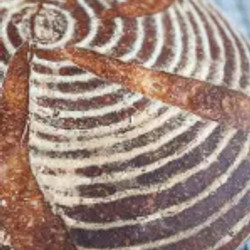
Activate the preferment (4-5 hours): In a medium bowl, whisk 2 TB sourdough starter into 100ml water until combined. Add 100g flour and mix just until you have a thick, craggy dough with no dry flour. Cover and rest in a warm place until mixture has doubled and looks thick and bubbly.
Make the dough/autolyse (~30 mins): In a large bowl, combine the preferment with 400ml water and 500g of bread flour, 50g of whole wheat flour, and 50g spelt flour. Mix just until all the flour has been hydrated. Cover with plastic and let rest 30 minutes.
Stretch & fold + bulk fermentation (~4 hours): Uncover the bowl, sprinkle 2 tsp sea salt and a splash of water on top, and work in with hands until integrated. Either in the bowl, or on an oiled counter, begin to stretch-and-fold the dough for a few minutes, until it begins to feel elastic and a little 'bouncy.' Return the dough to the bowl, cover, and rest at room temperature for 30 minutes. Then remove plastic, pull and stretch the dough in the bowl 4-5 times, then re-cover and let rest in a warm spot for 4 hours.
Shape the dough (40 mins): Prepare your final proofing container. Pre-shape: Turn the dough onto a floured surface (sticky side up), then gently pull and stretch the dough from the bottom to the middle to create a ball shape. If you prefer a batard or oblong shape, form the dough into a rough rectangle and fold one end halfway up the rectangle, then fold the other end in to meet it. Roll the dough into a rough log, using your fingertips to pinch together a seam along the length of the loaf and tuck and to seal the ends. Flip the dough over, cover with a tea towel, and rest for 30 mins.
Final proof (2-12 hours): Turn the dough ball into the prepared basket/bowl, seam side facing up, and dust with flour. Allow the dough to prove at room temperature for two hours, or until it slowly springs back when poked, or allow a longer proof in the fridge for 8-12 hours.
Final prep and baking (2 hours): Place a dutch oven inside your oven and preheat at 475-500 degrees for 30 mins – 1 hour. If dough has proved overnight in the fridge, remove and allow to rest at room temperature while the oven is heating. Test the dough: You’ll know it’s ready to bake when you poke the dough gently with your finger and it springs back slowly.
Turn the dough onto a piece of parchment paper, seam side down. Score the bread with a very sharp knife or razor blade. Remove the hot dutch oven from the oven and carefully transfer the dough into the pot. Spritz or sprinkle the dough with water, then replace the dutch oven lid, return to oven, and bake, covered, for 25 minutes. If using a dutch oven, reduce oven temperature to 450 degrees, remove lid, and bake 25-30 minutes more, until loaf is deep brown. Cool on a baking rack, avoiding slicing until the loaf is thoroughly cooled.