 Sort ingredients
 jamesfwguy
 QR Code
 Listen
 Pdf
Pdf
Preparing your oven - Preheat your oven to 170C / 340F (fan off), 150C / 300F (fan on). I like baking with the fan on for an even rise. Position your rack in the middle of the oven.
Preparing your cake tins - Spray the bottom (not sides) of two 20cm / 8-inch cake tins with oil spray and line the bottom with baking paper. I prefer just rubbing cold butter on the cake tins for better flavor.
Combine dry ingredients - In a medium sized bowl, whisk together the flour, baking powder and salt. Set aside.
Beat the eggs and sugar - Add the eggs to a large mixing bowl (glass or metal), and use an electric hand mixer to beat until frothy, about 1 minute. A stand mixer with a whisk attachment also works. With the mixer on medium-high speed, add the sugar a spoonful at a time. It’ll take about a minute. Once all the sugar is added, keep beating on medium-high speed for 6 minutes until the mixture is pale, thickened, and tripled in size.
Add dry ingredients to egg mixture - Add half the dry ingredients to the egg mixture and mix on low speed until just combined. Repeat with the rest. The batter will be thick. Avoid overmixing the batter, small lumps are fine, they’ll disappear in the next step.
Heat milk and butter - Heat the milk and butter in a saucepan over medium heat, stirring continuously, until it reaches about 60C/140F or small bubbles form around the edges. Do not let it boil. Alternatively, you can also do this in a heatproof jug in the microwave. Mine takes about 90 seconds for the butter to melt.
Add hot milk - Add half the hot milk mixture, along with the oil and vanilla. Mix on low speed until combined. Add the rest of the milk mixture and mix again until smooth. The batter will be thin and pour in a steady ribbon.
Divide the batter - Divide the batter evenly between the two cake tins. It works out to about 600g in each tin. Tap each tin on the counter a couple times to release any air bubbles.
Bake - Bake on the middle rack for 30–32 minutes, or until a toothpick inserted in the center comes out clean. The cakes should be deep golden and spring back when lightly touched. If they sink and don’t spring back, bake for a couple more minutes.
Cool the cakes - Let them cool in the tins for 10 minutes, then run a knife around the edges to loosen. Transfer to a cooling rack, placing them baking paper side down, and let them cool completely.
To level off the cake (optional) - Use a large, serrated knife or cake leveler to very top of each cake to level it off. This is completely optional. The cake bakes pretty flat anyway.
While the cakes are baking and cooling, you can prepare the frosting. My favorite frosting for this cake is Ermine Frosting. It has a lush vanilla flavor, almost like pastry cream.
To layer the cake - Peel the baking paper off each cake layer before assembling. Spread a small dab of frosting on your serving plate or cake board, then place the first cake layer on top. Evenly spread ⅓ of the frosting over it, using a cake turntable and offset spatula if you have them to make this an easier process. Place the second cake layer on top and press down gently.
To crumb coat the cake - A crumb coat is a thin layer of frosting that seals in loose crumbs for a smoother final layer. Spread a light coat of frosting over the top and sides of the cake, using an offset spatula and a cake turntable for an even finish.
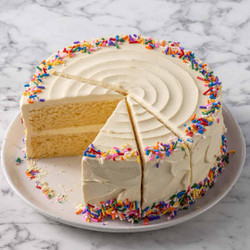
Final decoration - Spread the remaining frosting over the top and sides of the cake. For a textured look, use an offset spatula to create soft waves. To make a spiral pattern on top, place the spatula in the center, then slowly spin the cake turntable while moving the spatula outward in a circular motion. Finish with sprinkles around the top edge and base of the cake.