 Sort ingredients
 davidcee
 QR Code
 Listen
 Pdf
Pdf
In a large glass mixing bowl, combine the flour and kefir. Mix well with a spatula until a shaggy dough forms. The dough will be sticky and wet.
Tightly cover the bowl with plastic wrap and place it into the fridge. Let the dough rest and proof for 4-6 hours (up to 12 hours). The longer the dough rests, the better the flavor will be but the dough will also be wetter and harder to work with if rested too long.
About 30 minutes before baking, preheat your oven to 450°F (232°C). Place a large Dutch oven (4.3 quarts or bigger) with its lid on in the oven while it preheats. This is important. The dutch oven needs to preheat before adding the bread.
After the dough has rested, wet your hands with some water. Grab one side of the dough, stretch it upward, and then fold it over the center of the dough. Repeat this process from all eight sides of the dough.
Lightly flour a work surface with self-rising flour. Carefully turn the dough out onto the floured surface, seam side down. Use a bench scraper or lightly floured hands to rotate and drag the dough towards yourself on the floured surface, until you form a round, taut ball.
Place the shaped dough, seam side down, onto a piece of parchment paper.
Remove the preheated Dutch oven from the oven. Remove the lid and carefully transfer the parchment paper with the dough into the hot Dutch oven.
Put the lid back on and place it back into the oven to bake covered for 30 minutes.
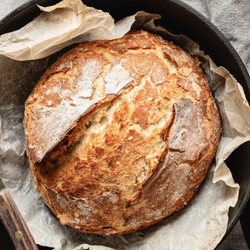
After 30 minutes, remove the lid and continue baking the bread for another 15-20 minutes or until the bread is browned on the surface and sounds hollow when tapped on the bottom.
Let bread cool fully before cutting and serving.