 Sort ingredients
 rich-insurance12
 QR Code
 Listen
 Pdf
Pdf
Preheat the oven to 350F. Butter and flour three 6-inch cake pans. Add on damp baking strips. Zest and juice a lemon.
In a standing mixer, sift in the flour, baking powder, salt and sugar. Give it a whisk and set aside.
In a large bowl, add egg whites, milk, elderflower syrup, lemon juice, lemon zest and sour cream. Whisk together.
Add a paddle attachment to the stand mixer. Add in room temperature butter in cubes or pieces.
Switch to a whisk attachment. On medium speed, beat for ½ of the wet mixture into the crumby dry mixture. Scrape the bowl down and add the remaining wet mixture. Beat until combined.
Pour the batter into the pans. I use a kitchen scale for more precision.
Bake for 33 - 36 minutes and/or until a toothpick inserted comes out clean.
Let the cake layers cool in their pans for about 5 minutes, them dump them out onto a wire rack to cool to room temperature.
Cut cold butter into 1 inch cubes.
Strain the egg yolks through a sieve. Beat with a french whisk.
While mixing, add in the sugar. It’ll turn into a light lemon color.
Add lemon juice in.
Transfer the bowl to a medium low heat while whisking constantly.
Once it hits 170F, it will change consistency. This can be tested by dipping the back of a wooden spoon and running your finger through.
Add in the cubed butter.
Pour into a bowl, cover with plastic and transfer to the fridge to set for a few hours.
Transfer to a piping bag for assembly. Snip off the tip.
Add egg whites, sugar and salt in a bowl.
Give the mixture a brief whisk.
Place the bowl over a pan of simmering water. Make sure the water does not touch the bowl.
Whisk the egg whites occasionally while it warms up. When the mixture has warmed, whisk it constantly. You will heat the mixture until it reaches an internal temperature of 160ºF or until it's not grainy between your fingers.
Transfer the bowl to a stand mixer with a paddle attachment. Whip until you get room temperature glossy peaks.
While the mixture is running on low, add tablespoon sized dollops of room temperature butter making sure to let the butter incorporate before you add the next piece.
Add in the elderflower syrup.
Transfer it to a piping bag. Snip off the tip when ready to use.
In a stand mixer fitted with a paddle attachment, cream the room temperature butter until smooth.
Sift in the confectioner’s sugar. You can add the sugar in two batches.
Beat until you get to a desired consistency. Add a few drops of rose water. Make sure the buttercream is thick.
Dye a few batches yellow, soft pink and pink. Use some matcha powder to create a natural leaf color.
Transfer buttercream to piping bag fitted with a 120 tip to make the petals.
Cut a square of parchment paper. Use a tiny bit of buttercream to glue down the paper onto a piping nail.
For the roses, pipe a small cone of very thick buttercream in the middle of the square. Add bits of yellow in the middle for added dimension.
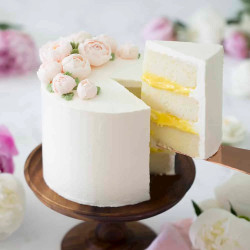
Pipe a thick ring of swiss buttercream along the perimeter of cake layer. Pipe in the lemon curd in the middle. Add the next layer and repeat the process.
Transfer to the fridge to chill for a few minutes.
Add swiss buttercream on the outside of the cake.
Smooth the Swiss buttercream with a bench scraper and offset spatula. Chill the cake again. If you're baking in a warmer climate, keep the cake in the fridge until you're ready to add the roses on.
Pipe a crescent ring of Swiss buttercream on the top of the cake.
Use scissors to transfer roses to the ring.
Pipe in leaves with a 68 tip to create some more dimension.