 Sort ingredients
 cmdandridge
 QR Code
 Listen
 Pdf
Pdf
372g Strong white bread flour
47g Wholewheat flour
279g Water
93g Levain
I make my levain at 22:00 the night before I'm going to bake. Using a small amount of starter to inoculate the levain gives me an extended fermentation period at 25C/77F. You can adjust this to suit your schedule. The recipe for the levain makes a little more than needed, which accounts for loss during the fermentation period and any residue left inside the jar.
Mix all of the ingredients for the levain together in a jar and leave to ferment until ripe, expanded, sour and fruity. Make sure your jar is large enough to accommodate the levain expanding by 3-4 times in volume.
Add 279g of water to your mixing bowl and dissolve 9g of salt by stirring with a spoon.
In a separate bowl blend 372g of strong white bread flour and 47g of wholewheat flour together until they are well mixed.
Add about half of the flour to the water mixture and quickly stir to create a porridgy consistency.
Add 93g of ripe levain to the bowl containing the water and flour mix. Stir well with a spoon to distribute the levain.
Now you can add the remaining flour to the dough. Bring the mixture together with a spoon and finish mixing by pinching the dough together with your fingers. (Wetting your hand will help to stop the dough from sticking too much).
Once you have formed a rough dough you can cover the bowl and leave it out at room temperature to rest for 30 minutes.
Turn the dough out onto your bench. Using the heel of your hand work the dough to make sure all of the ingredients are well combined and the dough is sufficiently mixed - this takes 1-2 minutes. Shape the dough into a ball, cover and leave it to bulk ferment at room temperature.
After 1 hour, turn the dough out onto your work surface. Gently pull the dough out into a rectangle. When you feel the dough resist you can stop pulling. Now fold the dough up into a square and shape the dough back into a dough ball. Cover and leave again at room temperature.
The dough needs to be left to increase in size by approximately 75% before moving on to the next step. Watch the video that accompanies this recipe to learn more about judging fermentation correctly.
Once the dough is correctly fermented you can dust the top with a little flour and gently turn it out onto your worktop. Gently ease the dough out into a circle. Fold the sides into the centre and flip the dough back over and then gently ease the dough into a loose ball again. DO NOT cover the dough, leave it out on the bench to rest for 15-20 minutes.
While the dough is resting you can lightly coat the inside of your bread tin with olive oil.
After the dough has rested lightly dust the surface with flour and flip the dough over. Gently ease the sides of the dough outwards and then fold them into the centre. Starting at the edge furthest away, roll the dough up towards you trying to maintain tension on the outside surface of the dough. Pinch the seam closed where the dough joins onto itself. (The main goal here is to create a taut sausage shape that fits in your baking tin, don't overthink it! Watch the video to see how I do it).
Place the dough into the baking tin with the seam side facing down. Cover the tin with a bag to prevent skin from forming on the surface of the dough. Leave to proof for 2-2.5 hours at room temperature.
Once the dough is sufficiently proofed it should feel inflated, soft and cushiony. You can bake the dough now but I prefer to cover it again and leave it in the fridge overnight and bake it the next day.
Place your baking stone on the lower third shelf of the oven and preheat to 220C/430F on conventional bake mode.
Slide the loaf tin onto the stone and then slide a baking tray onto the top shelf of the oven directly under the heating element. This will protect the top of the loaf during the first part of the baking.
After thirty-five minutes you can remove the baking tray. Continue to bake for a further 15 minters until the top of the loaf is nicely coloured. The entire bake is carried out at 220C/430F. I make sure the internal temperature of my loaf reaches 97C/206F.
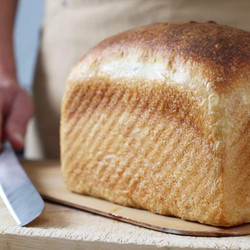
Leave the loaf to cool on a wire rack.