 Sort ingredients
 bufancy
 QR Code
 Listen
 Pdf
Pdf
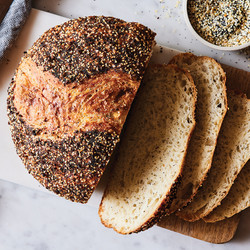
Weigh your flour; or measure it by gently spooning it into a cup, then sweeping off any excess. Mix the dough ingredients in a large bowl to make a sticky dough. Or beat in a stand mixer for 3 minutes., Cover with plastic wrap, and let rest at room temperature overnight, or for at least 8 hours; the dough will become bubbly and rise quite a bit, so make sure it's in a large bowl., Lightly grease a 14" to 15" long lidded stoneware baker, or 9" to 10" round lidded baking crock. Our bread baking crock and bread pot are both great choices. , Turn the dough onto a generously floured surface; the dough will be slack. To shape the loaf, fold the dough over onto itself using a bench knife or well-floured hands. Because the dough is slightly sticky, it's best to work quickly., Place the dough in the prepared pan, smooth-side up., Cover and let rise at room temperature for about 2 hours, until a slight indentation remains when you poke it with your finger., Just before baking, spritz or brush the dough with water and sprinkle with about 1 tablespoon Everything topping over the dough. Using kitchen scissors, make several ½" deep cuts in a decorative pattern on the top of the dough to allow the bread to expand., Replace the lid on the pot and put it in a cold oven; set the temperature to 450°F., Bake the bread for 50 minutes (start the timer once the bread goes into the oven), then remove the lid and continue to bake for another 5 to 10 minutes, until it's deep brown in color, and a digital thermometer inserted into the center registers about 205°F., Remove the bread from the oven, turn it onto a rack, and cool before slicing., Store leftover bread in a plastic bag at room temperature for several days. For longer storage options, see our blog post, Freezing no-knead bread dough, for details.