 Sort ingredients
 sereneosl
 QR Code
 Listen
 Pdf
Pdf
Drain the cashews and place them in a large glass bowl. Bring a large pot of water to a boil. Once boiling, pour the water directly onto the cashews. Let sit 1-2 minutes, and drain the cashews again. This step will help kill possible bacteria.
Place the cashews in the bowl of a blender or food processor. Add 8 tablespoons of filtered water. Blend on high speed, scraping down the sides from time to time, until you get a very smooth cream. This step might take about 10 minutes, depending on your blender.
Open the probiotic capsules and add the powder to the blender. Add the Penicillium Candidum, and blend on high speed for another 10-15 seconds.
The cashew cream should be smooth but quite thick. If needed, add 1 tablespoon of water at a time until smooth. Do not add too much water or your mixture will be too liquid.
Let it ferment: Transfer the cashew cream to a clean glass bowl, cover it with plastic film to touch, and let it sit at room temperature for 24-48 hours in a dark place. This step is important to let the cheese ferment and get a tangy flavor. Note: The cashew cream should have small bubbles and a fluffy texture. This means the fermentation process worked.
Transfer the cashew cream to the refrigerator and chill for at least 4 hours (or overnight). The cashew cream will firm up a bit and become easier to work with.
Line 3 4-inch springform pans with parchment paper. You want to cover the bottom and sides. Alternatively, you can also use plastic film if you prefer. The goal is to prevent the cheese from touching the metal. Fill each pan with the cashew cream and press it down using plastic film, so it doesn't stick to your hands. Refrigerate overnight.
The next day, carefully remove the cheeses from their springform pans and place them in a container lined with parchment paper.
Sprinkle about ¼ tsp of salt over the top of the cheeses. Next, using a plate lined with parchment paper, very carefully flip the cheeses. Sprinkle the tops and sides with more salt. The cheeses will still be very soft, like cream cheese. Don't worry, they will be easier to work with after 3-4 days, as salt will remove some moisture.
Close the container and place it in your refrigerator (in the warmest area) or a room at a temperature of 52-56°F (11-13°C). Important note: You will age the cheeses at this temperature for the next two weeks. Do not store them at a temperature higher than 56°F (13°C). Also, the cheeses must stay in the closed container during the whole process, it will prevent them from drying.
Every day, carefully flip the cheeses. Always use clean hands or work with gloves (or plastic film) to make sure you are not touching the cheeses. If you see water or condensation in the container, remove it using a kitchen paper towel.
After 7 days, the cheeses will be a little bit firmer, and you should be able to place them on a plastic grid or chopsticks (that fits inside your container). This will allow airflow, and the mold will grow more uniformly.
Continue flipping the cheeses every day for the next 7 days. The mold will start to appear in the following days, if it hasn't appeared already.
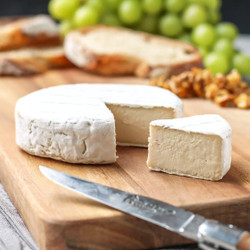
After a total of 2 weeks, the cheeses should be completely covered with a white and fluffy mold. At this point, wrap the cheeses in parchment or cheese paper and place them in the refrigerator for at least 2 days. The longer you let them age in the refrigerator, the sharper they will become.
Enjoy this vegan camembert with french bread, fresh figs, and/or nuts!
Vegan camembert will keep for up to 1 month in the refrigerator.