 Sort ingredients
 cindyyoung
 QR Code
 Listen
 Pdf
Pdf
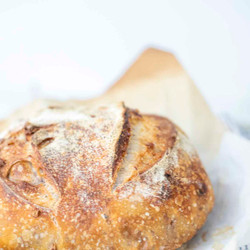
Feed your starter 4-12 hours before beginning this recipe so that it is active and bubbly.
In a large mixing bowl, add active starter, warm water, flour, and salt. Stir until combined, cover the bowl, and let the dough rest for 30 minutes.
Begin three rounds of stretches and folds. Reaching into the bowl, grab the edge of the dough closest to you and pull it upwards, letting it elongate (the stretch part). Press the edge that is in your hands back into the center (the fold part), press lightly, turn the bowl about a quarter turn, and repeat this two more times. This is one round. Cover the dough and let it rest for half an hour before the next round.
Perform the second round of stretch and folds, then cover and let rest for 30 minutes. During the final round, I find it easiest to empty the dough onto a work surface, add the fruit and nuts, and then complete the final round, incorporating the add-ins. Place the dough back into a banneton or a bowl lined with a tea towel.
Cover the bowl with a damp tea towel, plastic wrap, or a lid and let it bulk ferment in a warm place for 6-12 hours or until doubled in size. In a warm kitchen, this may take 6 hours or less, while in a moderately cool spot, it could take 12 hours or longer. Don't let it continue to ferment long past the doubling, or it may collapse and become sloppy.
With the first fermentation complete, turn the dough out onto a work surface dusted with a little flour, fold it in half, and roll. Shape it into a ball by gently spinning it towards you on the counter, creating tension. Optional: You can now let the dough sit out uncovered for 15-20 minutes so that the surface of the dough slightly firms up, preventing it from sticking to your lid, towel, or plastic during the overnight rise.
Shape the dough by folding each side into the middle, pinching them together, and repeating this process on the other two sides. The surface tension created will contribute to a better rise in the oven. Gently transfer the shaped dough, seam side up, into a floured banneton or bowl lined with a floured towel. Cover and let rise either in the refrigerator for 12-15 hours or at room temperature for 3-4 hours. I find the longer fridge rise is easier for scoring and may bring about a better rise.
Place your Dutch oven inside the oven, preheating it to 500 degrees Fahrenheit for one hour. Just before baking, remove the dough from the refrigerator and place it on a sheet of parchment paper. Dust with flour, score with a lame or razor blade, and carefully transfer the loaf to the hot Dutch oven. Cover with the lid and bake for 20 minutes. Remove the lid, reduce the temperature to 475 degrees, and bake for 15-20 minutes more until golden. Cool completely before slicing.