 Sort ingredients
 angelicab
 QR Code
 Listen
 Pdf
Pdf
Pour a glass of water over the dried porcinis and cook over a low heat for 30 minutes. (This can be done in advance e.g, a day before.).
Once that’s done, it’s worth keeping the remaining ‘mushroom water’; it’s useful in flavouring other dishes such as stews and soups. Keep it refrigerated or freeze it.
Peel the onion, slice it finely. Do the same with chestnut mushrooms and cooked porcinis.
Heat up a tablespoon of oil in a frying pan. Sauté finely chopped onion for a few minutes over a medium heat, until it turns translucent.
Add minced garlic clove and continue frying for another 30 seconds, stirring along the way. Add all the mushrooms we chopped, together with a teaspoon of dried thyme and a pinch of nutmeg. Season with salt and pepper.
Reduce the heat to ‘low’ and cook the mushrooms gently, stirring occasionally. Mushrooms will release their juices first, and then they’ll evaporate.
As the pan gets dry, add in 3 to 4 tablespoons of white wine, increase the heat to ‘medium-high’ and continue cooking until the wine evaporates completely. Make sure to stir from time to time, so that nothing sticks too badly to the pan.
Have a taste - does it need more seasoning? If so, add a bit more salt and pepper. Add finely chopped parsley leaves.
To make ‘Uszka’ assembly a bit easier, it’s worth grinding down the filling even more. You can use an immersion (hand-held) blender, or just chop everything again with a knife.
I enjoy a little bit of texture in the filling, so I divide the mass into two. I leave one part as-is (straight off the pan) and grind the other part with a blender into a smooth paste. Then I combine the two.
Store the mushroom filling in the fridge, until you’re ready to assemble the dumplings.
Sift the flour and salt into a large bowl. Pour in a tablespoon of oil.
Gradually pour hot water into the flour, mixing with a spoon as you go.
Dust your work surface with flour. Move the dough ball onto it.
Knead the dough until soft and smooth.
Form a ball, cover it with a kitchen cloth and set aside to rest.
Sprinkle the worktop with flour. Divide the dough into four parts. Roll each part (keeping the rest covered) into a thin layer of dough - like super-thin! 0.04-0.08 in (1-2 mm).
Using a rim of a small glass (or a round cookie cutter), cut out circles from the dough.
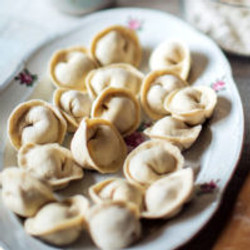
In the center of the cut circle, put about half a teaspoon of the filling and glue it together, forming a crescent (just like for pierogi).
Then connect both ends to form a ring - it's best to wrap the dumpling around your little finger and stick the ends together. If it’s not sticking, wet the ends with a tiny bit of water.
Place the ready-made ‘Uszka’ on a pastry board or your work surface, sprinkled with flour. Cover them with a cloth until you’re ready to cook them all.
Prepare a pot of boiling water and salt it generously. Throw in a few 'Uszka' dumplings at a time, but not too many - so that they don't lower the water temperature significantly.
After throwing them into the water, stir the dumplings very gently. We don’t want them to stick to the bottom.
Once the dumplings start to float, continue cooking for another minute.
Using a slotted spoon, retrieve cooked ‘Uszka’ and place them on a plate - but make sure they don’t touch each other (they tend to stick).
Once they cool ever-so-slightly, serve them in your borscht. Otherwise, wait for them to cool completely and move into a container with a lid, then refrigerate.