 Sort ingredients
 helen
helen QR Code
 Listen
 Pdf
Pdf
For the tangzhong paste: Place the water and starch in a microwave-safe bowl and whisk to combine. Cover loosely and microwave in 30 second intervals until thickened to a paste, 1 to 2 minutes, whisking regularly. Uncover and allow to cool for 15 minutes.
For the dough: Add the eggs, yolks, honey, and yeast to the bowl with the tangzhong paste and whisk until uniform. Transfer the mixture to the bowl of a stand mixer fitted with a dough hook, add the flour, and mix on low speed until the dough just comes together and no dry flour remains, 2 to 5 minutes. Cover loosely and let sit for 20 minutes.
Add the oil and salt to the bowl and mix on medium speed until the dough is silky and starts to clear the sides of the bowl (it will remain webby and sticky), 8 to 12 minutes. Desired Dough Temperature: 75°F.
Transfer the dough to another bowl if necessary (or proof in the mixer bowl). Cover and let sit at 75˚F until about doubled in volume, 90 to 120 minutes, folding the dough at 45 and 90 minutes.
For the filling: Whisk together the za'atar and flour in a small bowl until uniform. Add the oil and whisk until uniform.
For the babka: Line a 9- by 5-inch loaf pan with parchment paper (or coat with nonstick oil). Transfer the dough to a lightly-floured counter. Flour the top of the dough and roll into an 18- by 14-inch rectangle with the long side facing you. Spread the za’atar filling evenly over the dough, leaving ½ inch uncovered on the side closest to you and ¼ inch on the remaining sides. Using a finger dipped into a small bowl of water, moisten the edge of the dough closest to you. Starting at the edge farthest from you, roll the dough into a tight, even spiral, pressing gently to seal the seam closed.
Using a sharp knife, divide the dough in half crosswise into two logs. Working with one log at a time, cut the log in thirds lengthwise, leaving the three strands connected by about ½ inch of dough at the far end. Braid the strands, pinching them at the end to seal the braid together. Flip the braid over and, starting with the attached end, gently roll it up like a carpet into a tight ball. Place the ball seam side down in the prepared pan with the braid perpendicular to the long sides of the pan (the “sides” of the braid should face the short ends of the pan). Repeat with the remaining log of dough. Space the two balls of dough evenly apart. Cover the pan loosely and allow loaf to proof until it is about doubled in size, 60 to 90 minutes.
Thirty minutes before doughs are doubled in volume, set an oven rack to the middle position and heat the oven to 325˚F.
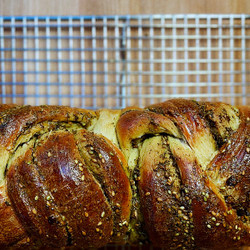
Brush the exposed surfaces of the loaf with the egg wash and transfer to the oven. Bake until the loaf is deep golden brown and a thermometer inserted into the center of the loaf reads at least 185˚F, 45 to 55 minutes, rotating the loaf after about 25 minutes.
Transfer the pan to a rack and allow to cool for 10 minutes. Remove the loaf from the pan, return to the rack, and allow to cool for at least 1 hour before slicing and serving.