 Sort ingredients
 mona
mona QR Code
 Listen
 Pdf
Pdf
Build the liquid levain in the morning and store somewhere around 78°F (25°C).
For the autolyse, mix flour and water (reserve 100g of the total water for later mixing) in a bowl until all dry bits are hydrated. Cover bowl and store somewhere warm (around 78°F/25°C) for 2 hours.
Add the mature levain and about 25g of the reserved water, mix thoroughly by hand to incorporate, and then slap and fold for about 6 minutes, just until the dough starts to show signs of a smooth surface and holds its shape on the counter. When finished sprinkle the salt on top of the dough and use the remaining 75g of water to help dissolve. Keep folding the dough until all the water is absorbed and it comes together; it will end up slightly sticky. Transfer dough to a tub or thick-walled bowl for bulk fermentation.
Bulk fermentation should go for a little less than 4 hours at 78°F (25°C) ambient temperature. Perform five sets of stretch and folds during the bulk, spaced out by 30 minutes. After the fifth set of stretch and folds, let the dough rest for the remainder of bulk.
Sprinkle a light dusting of flour on your bench and dump out the dough. Shape into a single round mass and let rest 20 minutes uncovered. Because this dough is highly hydrated, rely mostly on your bench knife and try to touch the dough as little as possible. Shape the dough into a tube the width of the baking pan and place it in the pan with as much tension on the surface as possible.
Cover your pan with plastic and then retard in the refrigerator at 38°F (3°C) for 10-14 hours.
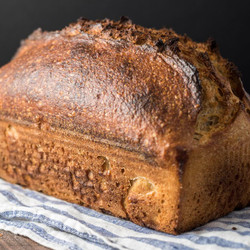
Preheat oven at 450°F (230°C) for one hour. Score the dough and bake for 20 minutes at 450°F (230°C) with steam, and an additional 30 minutes at 450°F (230°C) without steam. Then, turn the oven down to 425°F (220°C) and bake for an additional 15-20 minutes until done.
Let the bread cool in the pan on a wire rack until cool enough to remove, then further cool directly on the wire rack for a few hours.