 Sort ingredients
 sereneosl
 QR Code
 Listen
 Pdf
Pdf
Mix the water with the flour. Start by adding the flour to a mixing bowl. Next, bring the water to a boil and pour it into the bowl containing the flour. Using a wooden spoon, mix the flour with the water until it forms a thick paste.
Cover and refrigerate. Cover with plastic wrap and refrigerate for at least 5 hours, preferably overnight.
Once the Yudane has rested long enough, you can prepare the brioche dough.
Add the wet ingredients to a stand mixer. To the bowl of a stand mixer, add the plant-based milk, orange blossom water, and vanilla extract.
Add the dry ingredients. Then, add the instant yeast, bread flour, sugar, vitamin C powder, and Yudane. Note: Do not add the salt yet as it could kill the yeast. We will add the salt a bit later.
Knead on low speed. Using the dough hook attachment, knead the dough on speed 2 for 5-7 minutes. At this point, the dough will still have a slightly grainy texture.
Knead on medium speed. Add the salt and knead on speed 4-5 for about 20 minutes or until the dough passes the windowpane test. The dough should be very smooth and stretchy. Do not add more flour, the dough is supposed to be soft and sticky.
How to do the windowpane test: Take a small ball of dough, flatten it, and stretch it into a rectangle between your hands. As you stretch it, the dough should become very thin, almost see-through, and should not break easily. That means the gluten network is strong enough. On the opposite, if the dough is not elastic enough and you cannot stretch it into a thin layer, it means you must knead it for a longer period of time.
Slowly add the butter. Once your dough has passed the windowpane test, it’s time to incorporate the butter. As the stand mixer runs on speed 4-5, slowly add the diced butter. I recommend adding just a few cubes of butter at a time and adding more once it is fully incorporated. It should take about 5 minutes for all of the butter to be fully incorporated into the dough.
First rise. Transfer the dough to a mixing bowl and cover it with plastic wrap touching the dough. This will prevent it from forming a crust. Let the dough rise in a warm place for about 45 minutes.
Second rise. Next, punch the dough to deflate it and cover it with plastic wrap again. Allow it to rise slowly in the refrigerator for at least 4 hours, preferably overnight. This will allow the flour to absorb the butter, resulting in a better flavor.
Prepare a loaf pan. Lightly grease a 9×5-inch loaf pan with butter.
Divide the dough. Remove the dough from the refrigerator and gently punch it to release the air. Divide it into 8 pieces of 3 ounces (85g). Note: You will have some leftover dough. You can use it to make small buns or individual brioche.
Roll into balls. Working with one piece of dough at a time, roll it into a smooth ball on a lightly floured (or oiled) work surface.
Transfer to a loaf pan. Transfer each ball of dough to the prepared loaf pan and arrange them in four rows of two.
Let it rise. Cover the pan with plastic wrap and allow the dough to rise in a warm spot for 90-120 minutes, or until it is just about 1 inch under the top of the pan.
Preheat the oven to 350 °F (175°C).
Make the “egg wash”. In a small bowl, mix together 1 teaspoon of maple syrup with 1 tablespoon of plant-based milk. Set aside.
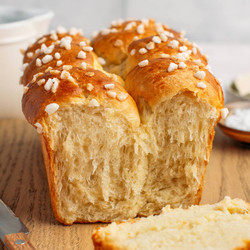
Bake. Finally, brush the brioche with the vegan “egg wash” and bake for about 30 minutes or until the top of the brioche is golden brown.
Allow the brioche to cool for about 10 minutes before removing it from the pan. Let it cool for another 25 minutes before enjoying it!
You can store this brioche in a large freezer bag closed with a twist-tie. The brioche will stay soft for up to 7 days at room temperature.