 Sort ingredients
 tofuleekheart
 QR Code
 Listen
 Pdf
Pdf
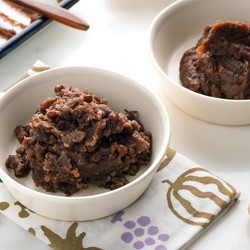
Gather all the ingredients.
Rinse 7 oz azuki beans and discard any broken beans. Drain.
Transfer the drained azuki beans to a large pot. Add enough water to the pot to cover the beans by 1–2 inches.
Place the pot on the stove and bring the water to a boil over medium-high heat.
Once boiling, drain the beans in a fine-mesh sieve. Return the beans to the same pot.
Next, add more water to the pot to cover the beans by 1–2 inches.
Bring the water to a boil over medium-high heat. Once boiling, put an otoshibuta (drop lid) over the beans. (The otoshibuta will prevent the beans from dancing around too much.) Turn down the heat to medium low and keep it simmering for the next 1–1½ hours.
Some of the water will evaporate, so add more water to keep the beans covered, as needed. After 1 hour, check if the beans are cooked. Pick up a bean and mash it with your fingers. When it mashes easily, it‘s done.
Drain the cooked azuki beans in a sieve.
Return the beans to the same pot. Turn the heat to medium low and add half of the ¾ cup sugar.
Mix well. Once the sugar has dissolved, add the rest of the sugar.
Mix well, stirring constantly. Then, add ½ tsp Diamond Crystal kosher salt and stir.
If you plan to use the red beans for Zenzai (Oshiruko), you can use it right away. If you prefer a thicker version, reduce the soup further.
Let the moisture evaporate. When you can draw a line on the bottom of the pot with your spatula, turn off the heat. Don‘t worry if it‘s still loose; the anko will continue to thicken as it cools. Transfer the anko to a flat baking sheet to let it cool completely. The tsubuan is now ready to use in a variety of Japanese sweets such as Daifuku Mochi, Anpan, Red Bean Pancakes, and Matcha Zenzai (Red Bean Soup). Scroll down to see how to store it.
Reserve some of the cooking liquid. Then, drain the azuki beans in a sieve.
Transfer the beans to a food processor. Run the food processor until the beans become a fine paste. If necessary, add 1–2 Tbsp cooking liquid to help process the beans.
Transfer the fine paste back into the same cooking pot. Turn the heat to medium low and add half of the ¾ cup sugar.
Mix well with the bean paste. Once the sugar has dissolved, add the rest of the sugar.
Let the moisture evaporate, stirring constantly. Then, add ½ tsp Diamond Crystal kosher salt and stir.
When you can draw a line on the bottom of the pot with your spatula, turn off the heat. Don‘t worry if it‘s still loose; the anko will continue to thicken as it cools. Transfer the anko to a flat baking sheet to let it cool completely. The koshian is now ready to use in a variety of Japanese sweets such as Strawberry Mochi (Ichigo Daifuku), Sakura Mochi, Manju, and Mizu Yokan.
Transfer the Anko to an airtight container, cool, and store in the refrigerator for up to 3–4 days or in the freezer for up to 2 months. You can also divide and wrap 100 g portions of the bean paste in plastic film and store in a freezer bag. When you’re ready to use it, defrost it in the refrigerator overnight. Tip: Compared to store-bought red bean paste, homemade anko uses less sugar and therefore doesn‘t keep as long.