 Sort ingredients
 dh_bressler
 QR Code
 Listen
 Pdf
Pdf
The night before you plan to make your bread, combine 15g starter, 77g water, and 77g unbleached bread flour in a jar. Note: This is a 1:5:5 feeding ratio. Optional: 30-60 minutes after you combine these ingredients, mix again for about 30 seconds. This helps encourage gluten development in your starter, which will translate to a better loaf later on!
In my 75°F home, my starter peaks around the 10-hour mark and stays peaked for around 7 hours (at the 1:5:5 ratio from Step 1). You want the top of your starter to be flat and perhaps even starting to concave a little in the middle. For more help, visit Is My Sourdough Starter Ready to Bake With? How I Can Tell
Combine 950g unbleached bread flour, 50g whole wheat flour (optional), 660g warm water, 150g active starter, and 20g salt.Optional: you can mix the flours and water and let it rest for 30 minutes up to overnight. This is called an autolyse and can help make your dough more extensible. After it rests, you'd add your starter and salt and move on to the next step.
Mix until a shaggy dough forms and cover.Note: At this time, I would feed the leftover starter from my jar. You should have about 30 grams left over to feed.
Let the shaggy dough rest for 30 minutes.
Perform 4 sets of stretch and folds, each set 30 minutes apart.* You can also switch to coil folds for the final sets, which are gentler on the dough.Optional: during the second set of stretch and folds, you can add inclusions to your dough as long as they aren't sugar or syrup. For two loaves, you're looking at adding 350-400g of inclusions. You can separate the dough into two if you prefer different types of bread.
Let the dough ferment until it has visibly risen, is puffy and jiggles when you nudge the bowl, is domed on top, is not overly sticky to the touch, and passes the float test.** If your dough has maintained a temperature of 78-80°F up to this point, it will take about 4 hours (that timer starts when you mix the starter in your dough). Please refer to the Notes and the bulk fermentation deep dive earlier in this post to help you with this step.
Using a bench scraper, divide the dough into two pieces.
Shape each piece into a ball and let rest for 30 minutes.*
For a boule: Stretch dough into a circle, fold sides to center, pull top down, tuck and drag to build tension, and place in banneton seam side up.
For a batard: Stretch dough into a circle, fold sides to center, roll from top down, place in banneton seam side up. You can also try the caddy clasp, my new preferred shaping method!
Cover bannetons and refrigerate overnight. Ideal cold retard: 12-36 hours. Do not exceed 96 hours.
Preheat oven to 450°F with Dutch oven(s) inside.
Transfer dough to parchment, score, and place in Dutch oven. You can add ice cubes to the bottom of the Dutch oven if you want blistering on the outside of the bread.
Bake with lid on for 30 minutes.
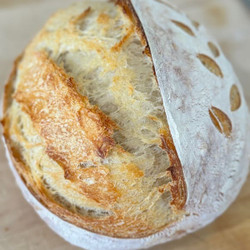
Remove lid, lower temperature to 425°F, and bake for 20-25 minutes until golden brown.
Cool on a wire rack for at least 2 hours before slicing.