 Sort ingredients
 kevinkr
 QR Code
 Listen
 Pdf
Pdf
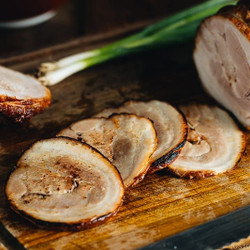
Make this easy, melt-in-your-mouth Chashu pork belly recipe at home! Braised in a sweet and savory sauce, these tender slices of meat can now top your next bowl of ramen!
Yields: 8
Gather all the ingredients.
Roll up the pork belly, making sure one or both ends has a “bacon-like” appearance, showing the varying layers of meat and fat. If your slab comes with the rind, it should be removed. Ask your butcher to remove it for you.
Run some butcher twine under the far end of the log. Tie a double knot to secure the pork tightly. Make sure you leave a tail of about 3 inches (7.5 cm) of twine at the end.
Next, tightly wrap the twine around the spot you just tied another 2 or 3 times to secure the starting point of the roll. Then, pull the twine to the opposite end of the pork belly roll. Tightly wrap the twine around that end 2 to 3 times to secure it.
Next, start wrapping the twine around the roll back toward the starting point. Space each wrap ⅓ inch (1 cm) apart. Make sure you wrap the roll as tightly as possible.
Once you reach the starting point, run the twine under some of the end wraps; this hooks the twine in place so you can reverse direction. Next, run the twine under 4 or 5 wraps going away from the starting point. Then, double back toward the starting point, running your twine under the wraps until you reach the original double knot.
Find the 3-inch tail of twine that you left when you started. Tie a double knot with the tail and the long end of the twine, and cut the excess.
Cut off the green part of the long green onion and slice the ginger.
Heat the oil in a cast-iron skillet (or regular frying pan) over high heat. Add the tied pork belly to the skillet.
Sear the pork belly one side at a time, rotating it to make sure all sides are golden brown.
It’ll take about 10-15 minutes all together.
While the pork is searing, put all the ingredients for the seasonings in a heavy-bottomed pot (I used a Dutch oven) that will fit the chashu.
Transfer the seared chashu to the Dutch oven.
Bring the liquid to a boil over medium heat.
Once boiling, skim off the foam and scum. Then turn the heat to low/simmer.
Put an otoshibuta (drop lid) on top to press the ingredients down and limit the evaporation. You do not need to use a regular lid to control the evaporation. If you don’t have an otoshibuta, you can make one with aluminum foil (here’s how to make the otoshibuta).
Simmer on low heat, and cover with the otoshibuta at all times for the next 2 hours, turning the chashu every 30 minutes.
The sauce has been reduced. After 2 hours, turn off the heat to let it cool a little bit.
Once the meat is slightly cooled, transfer it to a container or a plastic food vacuum-sealing bag, such as one for the FoodSaver system. Strain the leftover cooking liquid through a fine-mesh strainer. You will have roughly 2½ cups of liquid.
Add ½ cup of the cooking liquid into the bag. If using a container, add about 1 inch (2.5 cm) of the cooking liquid to the bottom and cover.
If using the FoodSaver bag, seal it with a FoodSaver sealer. Tip: Fold a piece of paper towel to plug the entry of the FoodSaver bag. This paper towel will absorb any extra moisture when you seal.
I also made quick Ramen Eggs (Ajitsuke Tamago) with the leftover liquid. Simply cook and peel soft-boiled eggs, add them to a bag with ½ cup of the cooking liquid, and close. Cover the cooking liquid, and store the chashu, ramen eggs, and the cooking liquid in the refrigerator.
Open the bag of chashu.
Cut the twine with kitchen shears and remove the twine pieces completely.
Slice the chashu into ¼-inch pieces and keep the end piece for Chashu Fried Rice!
Place the chashu slices on a ceramic plate and use a propane torch or broiler to sear the chashu slices to enhance the flavor. Enjoy them immediately or serve on your ramen.
Scoop up and discard the solidified fat from the cooking sauce.
Strain the sauce over a fine-mesh sieve to make sure the solidified fat is left behind. Pour the sauce into a mason jar or container and seal. The sauce will last for a month in the refrigerator. I use it for drizzling over the chashu and for making stir-fried dishes, marinades, and ramen eggs.
You can store the chashu in the refrigerator for up to 7 days or 1 month in the freezer. I usually divide the rolled chashu into thirds and freeze 2 portions separately (for ramen right away, and Chashu Fried Rice and Chashu Bowl for later). Ramen Eggs should be consumed in 3-4 days if they are soft-boiled eggs and 7 days if hard-boiled eggs. The eggs get saltier the longer you keep them in the marinade, so remove them from the sauce when they have the right taste.
Gather all the ingredients. For small blocks of pork belly (about 1 lb), you don’t need to roll them up before cooking, and the simmering time is just 1 hour (instead of 2 hours).
Heat the oil in a cast iron skillet (or regular frying pan) over high heat. Sear the pieces fat-side down first, then flip them over to sear the other sides, which will take about 10 minutes.
While searing, put all the ingredients for the seasonings in a heavy-bottomed pot (or regular pot) that will fit the chashu. Add the chashu and bring it to a boil, skimming the scum and foam. Then turn the heat to low/simmer.
Put an otoshibuta (drop lid) on top to press the ingredients down and limit the evaporation. If you don’t have an otoshibuta, you can make one with aluminum foil (here’s how to make otoshibuta). Simmer on low heat for one hour, turning the chashu every 15 minutes and keeping an otoshibuta on at all times.
After one hour, there is ½ inch of liquid left in the pot. Now, you have 2 options. Option 1: If you’re serving it right away, remove the otoshibuta and further reduce the sauce on low heat until the sauce thickens and you can see the bottom of the pot when you draw a line through the sauce with a spatula. Option 2 (recommended): Transfer the chashu to a container or bag with a little bit of cooking sauce and refrigerate overnight. Strain the leftover cooking sauce, transfer to a jar, and refrigerate.
To serve, slice the chashu into ¼-inch (6 mm) pieces. You can use a propane torch or broiler to sear the chashu slices to enhance the flavor. If you stored the chashu overnight and don’t want to sear the chashu, you can reheat it by soaking it in hot cooking sauce.