 Sort ingredients
 ilikegoats
 QR Code
 Listen
 Pdf
Pdf
To make the choux: In a small bowl, whisk together the eggs and egg whites until homogenous. Transfer to a large liquid measuring cup and set aside.
In a medium pot over medium heat, combine 548 grams (2¼ cups plus 1½ teaspoons) water, the butter, granulated sugar, and salt. Melt the butter, whisking until smooth. Bring the mixture to a simmer, then add the all-purpose and whole-wheat flours, stirring vigorously with a wooden spoon until the mixture is homogenous. Turn the heat to low and cook, stirring, until a film forms on the bottom of the pot and the mixture is smooth and pulling away from the sides into a ball, 3 to 4 minutes. Transfer to the bowl of a stand mixer fitted with the paddle attachment (or a large bowl with a handheld mixer), and mix on medium speed until the mixture has cooled to room temperature, about 10 minutes.
Add the vanilla and lemon zest and mix until smooth, about 20 seconds. Scrape down the sides and bottom of the bowl with a rubber spatula.
Turn the speed to low and gradually add the eggs. Stop adding the eggs when the dough is shiny, thick, and smooth with a pipable consistency, 4 to 5 minutes. The choux dough should hang off the edge of the paddle attachment but not fall off. (You may have some leftover egg depending on the humidity of your kitchen and how long you cooked the choux dough.) Transfer the dough to a piping bag fitted with a size 828 star tip.
Line a half-sheet pan with parchment paper. Take a second piece of parchment paper and cut out fourteen parchment squares. Place a parchment square on a scale and tare the scale. Hold the pastry bag about 2 inches (5 centimeters) above the parchment paper and evenly pipe a 75- to 80-gram circle of choux dough, with one edge overlapping the end of the circle. The diameter of the doughnut should be about 4 inches (10 centimeters). Let the dough fall naturally; if you don’t like the shape of the cruller, scrape the dough off the parchment and return it to the bag to start over. Using the parchment square, carefully transfer the piped cruller to the prepared sheet pan. Continue with the remaining dough, refilling the piping bag as needed.
Transfer the crullers to the freezer until fully frozen, about 1 to 2 hours or ideally overnight (this will yield a more even fry). The crullers can be wrapped tightly in plastic and stored in the freezer for up to 2 months.
To make the poppy seed glaze: In a medium skillet over medium heat, toast the poppy seeds, gently stirring, until fragrant, 2 to 3 minutes.
In a medium bowl, whisk together the powdered sugar, lemon juice, milk, vanilla, and salt until smooth. Stir in the poppy seeds. Taste and season with more salt, if desired. Set aside.
Set a wire rack inside a half-sheet pan. Fill a deep skillet or pot over medium-high heat with 3 inches (7.5 centimeters) of oil and heat to 365°F (185°C). Remove the parchment squares from the crullers.
Carefully slide a cruller into the hot oil, ridged-side down. If the cruller flips, that’s fine—use tongs to gently turn it over. Add another one or two crullers, depending on how much space you have (don’t overcrowd the pot). Cook the crullers until the tops are puffed up and yellow and the bottoms are a deep chestnut brown and firm to the touch, 6 to 8 minutes.
Using tongs, gently flip the crullers and fry until the edges feel firm and the bottoms are deeply golden brown, 6 to 8 minutes. Transfer the crullers to the wire rack, allowing any excess oil to drip off. Repeat with the remaining crullers. Let cool completely on the wire rack.
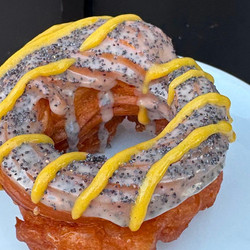
Gently dip the ridged top of the cruller into the glaze, swirling around to ensure an even coating. Return the cruller, glazed-side up, to the wire rack and sprinkle with poppy seeds. Repeat with the remaining crullers. Set aside until the glaze is set, 5 to 10 minutes.
Fill a piping bag with the lemon curd and cut a small hole at the bottom. Pipe the curd in stripes over the glaze. Serve the crullers immediately.