 Sort ingredients
 hmiller1219
 QR Code
 Listen
 Pdf
Pdf
Feed your starter 4-12 hours prior to beginning the recipe. This will give it the time it needs to be active and bubbly.
Add the flour, water, sourdough starter, olive oil, salt and sugar to your stand mixer with the dough hook attachment.
Mix on low speed for 2 minutes, producing a shaggy dough. Increase the mixer speed to medium for an additional 5 minutes, at which point the dough will be pulling away from the sides of the bowl, becoming more elastic and smooth in appearance.
Here you can test the gluten development with the windowpane test. Pinch off a small portion of the bread dough and use your fingers to pull it into a square shape, observing the center of this square. If it pulls thin enough to allow light through without tearing, your gluten development is satisfactory. If not, continue kneading with the mixer for 2-3 minutes more and try this test again.
Transfer dough to a well-oiled, large bowl, covered with a tea towel, plastic wrap, or beeswax wrap. You want it to be airtight so no hard skin forms on top of the dough from air exposure.
Rise until it has doubled in size, approximately 8 hours at room temperature. This may take more or less time depending on the temperature of your home and the maturity of your starter.
After your dough has doubled in size, place it onto a lightly floured work surface and divide in two. I like to use my bench scraper (dough scraper) for this, but a sharp knife works, as well.
To shape into a torpedo loaf, gently stretch each ball into a long rectangle. Fold each side into the middle, pressing the seam down. Apply tension to the dough by pulling it toward you on the counter, elongating the rectangle so that the shaped dough is about 12" long.
I like to speed this up by placing it in a warm spot, getting the time closer to the 2 hour mark. This could be in a high place where heat rises, near a heat source like a fireplace hearth, or even in a small room with a space heater.
If you're wanting to extend your rise time to better fit your schedule, or for any reason at all (longer fermentation, etc), you can also place your shaped loaves into the fridge at this point. Cover them and refrigerate. You can refrigerate for 12-15 hours (or more), then move forward to scoring and baking.
Transfer the dough to a baking stone or baking sheet lined with a sheet of parchment paper. Cover dough lightly and let rise until doubled, approximately 2 to 4 hours at room temperature.
Once doubled, preheat oven to 400 degrees.
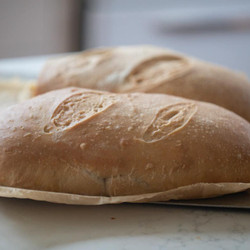
Score the top of the loaves with a bread lame or razor.
To create steam in the oven, there are several options. See in notes.
Bake at 400 for 35 minutes until golden brown. Rotating the loaves after about 20 minutes can help you to achieve a more even browning.
For best results, cool on a wire rack before slicing. However, I do love to enjoy this one warm from the oven, so I may give it a bit of time so that it's not blazing hot, but not fully cooled. Your call!