 Sort ingredients
 userdd6767
 QR Code
 Listen
 Pdf
Pdf
The night before you plan to make your dough, feed your starter. Mix together 14 g sourdough starter, 68 g water, and 68 g bread flour. This gives you 30 extra grams so you don't have to scrape out every last bit from the jar (you can also feed the leftovers to maintain your starter). At this feeding ratio, your starter should peak by morning (about 10-12 hours after you feed).
In the morning, mix 450 g bread flour, 50 g whole wheat flour, 120 g active sourdough starter, and 325 g of the 350 g water, reserving the remaining 25g for Step 2. (This is the beginning of the bulk fermentation.) Knead the ingredients together until fully incorporated and you have a shaggy dough. Cover with plastic wrap, a shower cap bowl cover, or cloth bowl cover, and let rest for about 1 hour.Optional: you can opt to do an autolyse by mixing just the flours and water and letting it rest for 30 minutes, up to overnight. Then, proceed by adding your starter.
Add 10 g sea salt and remaining 25g water. Dimple in and squeeze the saltwater into the flour. The dough will break up, get stringy, and feel rubbery. This is normal. Mist your counter with water and turn out the mass of dough onto your counter. Do slap and folds for 2-4 minutes, or until the dough smooths out and the saltwater is fully incorporated. Cover and let rest for 30 minutes.
Add inclusions (3 g Italian seasoning blend, 4 g lightly dried basil, 125 g mix of freshly shredded colby jack cheese and Parmigiano Reggiano) on top of the dough in the bowl. Stretch and fold the inclusions into the dough. Cover and let rest for 30 minutes.
Stretch and fold the dough. Cover and let rest for 30 minutes.
Coil fold the dough. Cover and let rest for 30 minutes.
Coil fold the dough. Cover and let rest for 30 minutes.
The dough strengthening is now completed, so we wait until the dough has finished its bulk fermentation.My two preferred ways to tell when bulk fermentation is done are:1) Follow The Sourdough Journey’s dough temping & percentage rise chart (i.e: if your dough is 75°F (23.8°C), let it rise 50% before moving on to shaping). You may have to experiment with this chart a few times before nailing down what works for you. It's better to overproof (let your dough rise for longer) than to underproof (cut things off too soon).2) Look at the dough – it should form a dome with the dough moving away from the sides of the bowl. There are bubbles forming underneath the surface. It should be visually larger and will jiggle if you shake the bowl. When you touch it, it’s light, airy, and puffy. For me, bulk fermentation took 7.5 hours; my dough was 70-72°F (21-22°C) and my home was 71°F (21.6°C), for reference. Warmer dough will be done faster; colder dough will take longer.
When bulk fermentation is done, dump out dough onto the counter. Gently pre-shape using a bench scraper to coax the dough into a tight ball. This is the end of the bulk fermentation.
Final shape the dough using the single caddy clasp method. Flip into a floured banneton, seam-side up. Pinch the seam shut. Optional: Let the dough rest for about 10 minutes. Stitch the top of the dough to increase surface tension and cover. Put in the fridge overnight.
The next day, at any time, preheat oven to 450°F/230°C with a Dutch oven inside.
Score the dough and place it in the preheated Dutch oven. Cover and bake for 30 minutes.
Remove lid and lower oven temperature to 425°F/220°C. Bake for an additional 15-20 minutes, or until the top is as golden brown as you prefer. Feel free to temp the bread to ensure it is fully baked. It should be around 205-210°F (96-99°C).
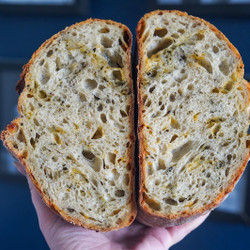
Wait for the bread to cool down, about 2 hours. Cut into the cooled bread and enjoy!!