 Sort ingredients
 ericalotta
 QR Code
 Listen
 Pdf
Pdf
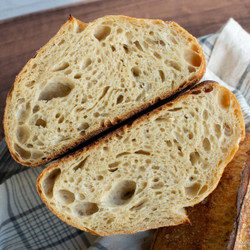
Mix together ripe sourdough starter, bread flour and water. Set aside to ripen for 10-12 hours.Note: Ripe, bubbly, active sourdough starter can be substituted for levain in this recipe if desired.
Fermentolyse in the Mixer: Once the levain is peaked and active (bubbly, doubled in size, milky sweet smell), mix 100 grams levain with 325 grams of water in the bowl of a stand mixer with a dough hook. Add 450 grams of bread flour and 50 grams whole wheat flour to the bowl and mix until just incorporated. Cover and let rest for 30 minutes.Note: Warm the water if the ingredients are too cold and cool the water if the ingredients are too warm.
Mix the Dough in a Stand Mixer: After 30 minutes, add the reserved salt and 25 grams of water to the dough. Turn on the stand mixer and knead for about 1-2 minutes until the dough is well combined. Cover the dough and let rest for 30 minutes.
Bulk Fermentation in the Mixer: Instead of doing stretch and folds by hand, this method uses gentle kneading in a stand mixer. Every 30 minutes for 1½ hours, uncover the mixer and knead the dough on low speed for 10–15 seconds. Cover and let it rest between each round. Repeat this 3–4 times until the dough feels strong and cohesive, then cover and let it continue bulk fermenting.
Finish Bulk Fermentation: Transfer the dough to a container and let it rest in a warm spot (around 78ºF) for 1½ to 2 hours. It should puff up by 30–40%, look more aerated, start pulling away from the sides, and show scattered bubbles on the surface. If it’s not quite there yet, make sure the dough is warm enough and give it another 30 minutes or so until you see those signs—it should look light and ready to shape.
Pre-Shape: Tip the bowl upside down, allowing the dough to fall on the counter surface. Wet your hands and the bench knife. Push the bench knife under the dough while using your free hand to tuck the dough under itself. Repeat this process going around in a circle until you have a tight ball of dough.
Bench Rest: Let the dough rest uncovered for about 30 minutes at room temperature. The dough will flatten a bit during this period of time.
Prepare a bowl: Prepare a banneton or small bowl. Place a kitchen towel or hair net in the bowl. Sprinkle flour in the bowl and cover with a light dusting so the dough doesn't stick. This dough also bakes well in a 9x5-inch loaf pan if you prefer a more traditional sandwich-style shape.
Shaping: After the dough has rested for about 30 minutes it is time to shape the bread into a round. Sprinkle flour on top of the dough. Using the bench knife, lift the dough up off the counter and place it on top of the countertop–floured side down. This ensures that the flour is staying mainly on the outside of the dough. Going around in a circle, pull the dough sideways towards you and then fold up to the top of the round. Move 90 degrees and repeat the same process pulling the dough sideways and then folding up to the top. As you continue this process around the dough, increase the tension as you pull. Gather the bread into a circle and use a bench knife to lift the bread and place into your lined bowl. Watch the process here.
Cold Fermentation: Cover the dough with a shower cap, plastic wrap or a reusable cover and store the dough in the refrigerator overnight or for up to 12-24 hours.Alternatively you can let your dough rise outside the fridge for another 2-3 hours, keeping the dough at that 78º F temperature, and then bake your loaf the same day.
Pre-heat the Oven: Put a dutch oven (top and all) into the oven and preheat to 500ºF for 30 minutes.
Prepare Dough: Once preheated, pull your first loaf out of the refrigerator. Remove the cover (this is easy to do straight out of the refrigerator if the dough is chilled–not easy if the dough warms up) and place a piece of parchment paper on top of the bread dough. Flip the dough over so that the dough is now sitting on the parchment paper. Take off the bowl/banneton and kitchen towel.
Scoring: Smooth the flour over the top of the dough (add a little extra for more contrast if desired). Use a very sharp knife or bread lame to score the dough. I use my bread lame to make any small decorative scores first that are just ¼-inch deep. Then make one or two larger/longer slashes that go across the dough about 1-inch deep. Watch the process here.
Bake: Carefully remove the dutch oven from the 500ºF oven with hot pads. Take the top off and place your bread into the dutch oven (including parchment paper–this helps with the transfer). Be very careful not to touch the sides of the dutch oven. Put your hot pads back on before you pick up the lid of the dutch oven and place it on top of the bread. Put the whole dutch oven back into your oven. Lower the temperature to 450ºF and bake for 25 minutes. Once 25 minutes are up, take the top off the dutch oven and continue baking for 20 minutes until the bread is a crackly deep brown. The loaf should register between 205-210℉ when it's finished baking. Remove to a cooling rack and let cool before slicing and enjoying.