 Sort ingredients
 willa
willa QR Code
 Listen
 Pdf
Pdf
For the Stir-Fry Sauce:
For the Noodles:
For the Stir-Fry:
If Using Fresh Noodle Sheets: Cut fresh noodle sheets into 1 ½-inch wide strips and place in a mixing bowl; set aside.
If Using Dried Noodles: In a large heatproof bowl, cover noodles with 1 quart boiling water. Allow the noodles to hydrate until pliable, 15 to 20 minutes. Drain thoroughly and rinse three times with cold water to remove excess starch. Return drained noodles to bowl and toss with oil until evenly coated and no longer sticky; set aside.
For the Stir-Fry Sauce: In a small bowl, whisk together oyster sauce, fish sauce, thin soy sauce, granulated white sugar, and white pepper until well combined; set aside.
For the Stir-Fry : In a mortar and pestle, pound garlic and Thai red chiles into a rough paste.
Heat a wok or large carbon-steel, stainless-steel, or cast iron skillet over high heat until lightly smoking. Add oil and swirl to coat the surface. Add garlic-chile paste and cook, using a large spoon or wok spatula to stir constantly, until fragrant but not browned, about 30 seconds; lower heat as needed to prevent garlic from browning.
Turn the heat back to high and add grachai, makrut lime leaves, and pork. Cook, stirring constantly, until the pork is almost fully cooked, about 40 seconds.
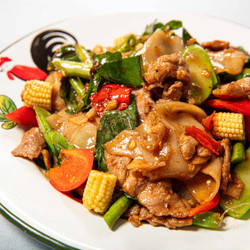
Add long beans, baby corn, and Chinese broccoli and cook, stirring vigorously, until vegetables are just starting to become tender and lightly charred in spots. Add prepared noodles, then pour the sauce in around the sides of the wok. Continue stirring and tossing until the sauce is fully absorbed by the noodles, about 2 minutes.
For Serving: Remove from heat and stir in sliced red chile and basil leaves until basil is just wilted. Serve immediately, offering additional fish sauce, white pepper, Thai chile flakes, sugar, and chile vinegar alongside for diners to stir-in to taste.
Notes
This recipe is best when prepared with fresh rice noodles, which come in sheets that can be cut by hand. Dry rice noodles are a good substitute if you can't find fresh, though the widest ones are not typically as wide as the fresh can be cut, and they have a chewier, more firm texture.
Lime leaves often come in a double-leaf form on each stem. Each of those double leaves (2 per stem) counts as one leaf here in this recipe.
A Holland chile and Fresno chile will have a similar mild heat level that is balanced with a sweet finish, while a fresh Cayenne chile will be spicier. A jalapeño chile may also be substituted in this recipe, though it will deliver less sweetness.
You can buy boneless pork shoulder and slice it very thinly yourself; par-freezing helps for thinner slices. You want roughly ⅛-inch thick slices that are about 1x1.5-inches in size. You can also buy pre-sliced pork as it is sold in Asian markets for hot pot instead.