 Sort ingredients
 amducharme95
 QR Code
 Listen
 Pdf
Pdf
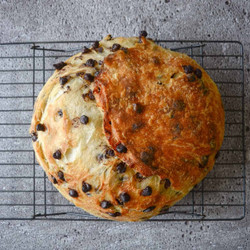
1:1:1 Levain: This recipe calls for a levain mixed the night before you mix the dough. Combine 42 g active starter, 42 g water, and 42 g all-purpose flour in a small bowl. Cover and let it sit at room temperature for 8 hours.
The levain is ready when it has doubled in size, has lots of bubbles, and a slightly sour aroma.
Grate 113 g (½ cup) unsalted butter into a small dish and refrigerate until ready to add to the dough.
Add 320 g (1⅓ cups) water and 500 g (4 cups) bread flour to a large bowl and mix with a Danish dough whisk until a shaggy dough forms and all of the flour is incorporated. I found that it helped to use my hands to work the final bits of flour into the dough.
Cover the bowl and rest for 30 minutes.
Combine 10 g (2 tsp) salt with the remaining 30 g (2 tbsp) water and stir to dissolve the salt.
Pour the salty water into the bowl over the dough with all of the ripe levain, and mix until fully combined. I find that my hands are the best tool for this job.
Squeeze and turn the dough until the levain and liquid are adequately distributed throughout the dough. At this point, the dough can look a bit stringy and not fully cohesive; this is ok!
Cover the bowl and let it rest for 30 minutes.
Over the next 2 hours, the dough will transform from a rough, shaggy croissant dough to a smooth and elastic dough through 5 sets of stretch and folds.
Grab the edge of the dough and lift it straight up before folding it over onto itself.
Turn the bowl a quarter turn, and repeat, working your way around the sides of the bowl. Initially, the dough will be loose, but after 10-15 folds, the dough begins to come together.
Continue to stretch and fold the dough roughly 30 times, or until the dough becomes resistant. This completes one set of stretch and folds.
Cover the bowl and rest for 30 minutes.
Continue stretching and folding the dough for a total of 4 sets with 30 minute intervals.
On the second set of stretch and folds, add half of the grated butter over the top of the dough. Using the same stretch and fold method, incorporate the butter into the dough.
Cover and rest for 30 minutes.
Add the remaining grated butter to the dough on the third set of stretch and folds. Cover and rest for 30 minutes.
Add the chocolate chips at the fourth set of folds, making sure the chips that fall to the bottom of the bowl get mixed in.
For the fifth and final fold, the dough will be elastic and smooth, with the grated butter and chocolate chips distributed throughout the dough.
After the stretch and folds are completed, cover the bowl and let it rest at room temperature. The dough is done fermenting when you see plenty of air bubbles beneath the surface, and the edge of the dough where it meets the bowl domes down slightly.
Turn out the dough onto a lightly floured work surface.
Using a bench scraper and one hand, rotate the dough while pushing the dough under with the bench scraper, into a boule shape.
Let the preshaped dough rest on the counter for 30 minutes uncovered. It's normal for the dough to flatten a bit as it rests.
Prepare your banneton by dusting it with a bit of rice flour to prevent the dough from sticking.
Fold the bottom of the dough up to the middle and gently press it into the dough.
Pull the right side of the dough out a bit to stretch it before folding it over the middle of the dough. Repeat with the left side of the dough.
Starting from the bottom of the dough ball, roll the dough onto itself until it forms a ball.
Use a bench scraper to lift the folded dough into the prepared banneton, with the seam side up. Pinch the seams together.
Place the banneton into a plastic bag and refrigerate for 8-24 hours. I like to do this step overnight.
The following morning, preheat the oven to 450F°/232C° with a Dutch oven in the middle of the oven for 30 minutes.
Turn out the chilled dough onto a piece of parchment paper. Score the top of the loaf roughly 1 inch deep with a lame or a sharp knife.
Carefully remove the hot Dutch oven from the oven and lift the bread using the parchment paper as handles, into the Dutch oven. Replace the lid and move to the oven. Lower the oven temperature to 425°F/218°C and bake with the lid on for 30 minutes.
Remove the lid and bake for 10-15 minutes. The bread is done when the internal temperature reaches 200°F/93°C and the top of the bread is golden brown.
Like most baked goods, they're best the day they're baked! Allow the bread to cool completely. Store bread in an airtight container and store at room temperature for up to 3 days.