 Sort ingredients
 willa
willa QR Code
 Listen
 Pdf
Pdf
Place the yeast and 325 ml (1½ cups) in a jug and stir to dissolve. Place the flours in a large bowl. Add the yeasted water and mix to combine. Add the salt and mix roughly (use a spoon or a chopstick). Cover and allow to prove at room temperature for 12-18 hours (depending on the climate) or until doubled in size.
Lift the risen dough out of the bowl and onto a floured bench. Give it a quick knead to bring it together. Stretch into a rectangle, then fold the dough onto itself in a ball. Place the dough, seam-side down in a cast iron pot lined with baking paper and dust the top with semola. Cover with a lid and stand at room temperature for 1-2 hours or until risen by two thirds.
To test if the dough is ready, poke it gently with a finger. If the indent is deep and doesn’t spring back at all, it has risen too much. If it springs back straight away it needs a little longer. If the finger leaves a little indent but the dough almost completely springs back, then it’s ready to bake.
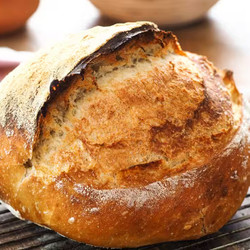
Sprinkle the top with semola, slash with a blade or a knife, and put the lid back on. Place the pot into the oven and turn on to 250°C. Bake for 40 minutes, then using oven mitts, remove the lid. Bake for another 10-15 minutes or until the bread has a burnt caramel colour. Remove the pot from the oven, tip the bread onto a wire rack and cool for at least 1 hour before slicing.