 Sort ingredients
 jeccad
 QR Code
 Listen
 Pdf
Pdf
Combine flour and water in a large bowl. Mix with a wooden spoon or dough whisk until it is thoroughly combined. Let sit for about half an hour so the flour can absorb the liquid. Then add the sourdough starter, salt, garlic and rosemary. Knead with wet hands about 5-10 minutes until all the ingredients are well combined and have formed a sticky ball.
Cover with plastic wrap or a damp kitchen towel and let the dough rest for 30 minutes. After 30 minutes, begin a series of coil folds. Perform a total of 4 coil folds every 30 minutes for the first 2 hours.
Cover the dough and allow it to rise until it has doubled in size. The amount of time that this takes will vary depending on the temperature in your kitchen. A warmer environment will cause the dough to rise much faster than a cooler environment.
Turn the dough out onto a lightly floured work surface. Tuck the edges underneath the dough ball and gently pull and push it away from you to build tension in the loaf. You want it to stick to your work surface just slightly so there is a little resistance there. Let the dough rest for 15 minutes.
Then, shape a loaf. Gently press the bread dough slightly flat without popping all of those precious bubbles. Fold in thirds like an envelope, and then gently roll it up so the seam is hidden. Pinch the seam and sides closed. Place the loaf seam side up into a floured banneton basket.
Cover the banneton basket with plastic wrap, a shower cap, or a plastic grocery bag tied up. You don't want the dough to dry out in the fridge. Refrigerate for 12-24 hours.
When you're ready to bake your bread, preheat the oven temperature to 500 degrees F. Place the dutch ovens into the oven to preheat as well. Make sure that each cast iron dutch oven has a tight-fitting lid. After 45 minutes to an hour, remove the hot dutch oven. Turn out the loaf of bread onto a piece of parchment paper. Lightly flour the top. This will make your scoring pattern stand out more.
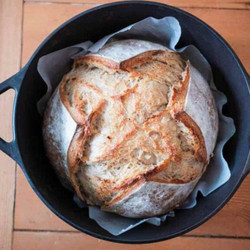
To score the dough - use a bread lame, a razor blade or a sharp knife to cut at least one deep cut into the loaf of bread. This can be curved or straight. This is called the expansion score. This is where the bread will expand instead of breaking apart in random places all over the top of the loaf. Next, if you'd like to, add smaller cuts to make a pattern or design. These cuts are called the decorative score, and should not be as deep.
Place each loaf into a hot dutch oven and bake for 25 minutes. This time of baking at high heat will give the loaf a beautiful oven spring. After 25 minutes, turn the heat down to 450, remove the lid and bake another 10-15 minutes, until the crust is golden brown. Bake it to your liking - the longer you bake it, the darker the crust will be.
Remove from the oven and cool on a wire rack for 1 hour before slicing.