 Sort ingredients
 mariajes
 QR Code
 Listen
 Pdf
Pdf
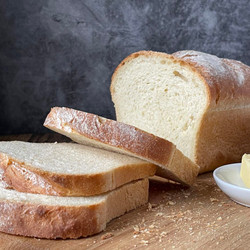
By hand: Mix the flour, softened butter, salt, sugar and yeast in a large bowl and make a well in the centre.
Add a little water. Mix thoroughly, adding a little water at a time until you have formed a ball of dough.
Transfer dough to a floured surface and knead for 10 to 12 minutes.
Check your dough is ready by using the windowpane test.
KitchenAid: Add flour, softened butter, salt, sugar and yeast to the mixing bowl, make a well and add the water.
Mix on slow speed number 1 for 1 to 2 minutes.
Turn up to number 2 speed for a further 8 to 10 minutes.
Check your dough is ready by using the windowpane test.
Place your dough in a large greased bowl and cover.
Leave to rest in a warm place for at least one and a half hours or until doubled in size.
Transfer the dough to an oiled work surface.
Shape your loaf by gently working your dough into a rectangle.
Roll up your dough from the short side.
Pinch the seams together and turn the loaf over so you have the long seam on the bottom.
Place in a greased loaf tin or tins.
Cover and leave to rise in a warm place for about 45 minutes.
Preheat oven to 230°C / 450 °F and place a shallow baking tin in the bottom of the oven.
Using a sharp greased knife, make 3 slashes in your loaf at a 45° angle before lightly dusting your loaf top with a little flour.
Place your bread in the oven and then quickly pour a cup of hot water into the pre-heated baking tin. Gently close the oven door.
Bake for 10 minutes at 230°C / 210°C fan / 450 °F.
Turn your oven down to 200°C / 180°C fan / 350°F and continue baking.
Large loaf: 30 to 35 minutes until golden brown. Small loaves 15 to 20 minutes until golden brown.
Tip your loaf onto a cooling rack and tap the base of the bread to check it is cooked, it should sound hollow.
Alternatively, check your loaf's internal temperature - ideally it should be around 90°C / 194°F to 95°C / 203°F.
Leave to cool.