 Sort ingredients
 cawlensing
 QR Code
 Listen
 Pdf
Pdf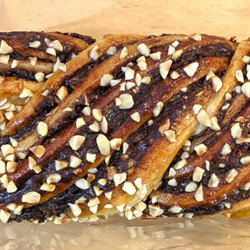
Dough
Filling
Syrup
Topping
Instructions
In a small saucepan, gently heat the milk and cubed butter. Avoid bringing it to boil and stir frequently to help the butter to melt, then let the mixture cool for about 5 minutes or until it's lukewarm.
Add the flour, yeast, sugar, and salt in the bowl of a stand mixer and mix with a paddle attachment on low speed. Add the egg, milk-and-butter mixture, vanilla extract, and orange zest. Mix on low speed for around 2 minutes, or until the dough starts coming together. Then switch to a dough hook and mix for another 4-5 minutes on medium speed, until you have smooth and elastic dough that doesn't stick to the sides of the bowl and passes a windowpane test.
Place the dough in a lightly greased bowl or straightwalled container, cover, and let it rise until it has doubled in size. If using the cold bulk rise method, refrigerate the dough immediately after mixing for 8-12 hours or overnight. If using the room temperature method, doubling should take 1-2 hours.
Before proceeding with shaping, warm up your refrigerated dough at room temperature for about 30 minutes -- or -- chill your room temperature dough in the freezer for 10-15 minutes or in the refrigerator for 30 minutes.
Filling & Shaping (See the detailed shaping instructions and videos above)
Grease two 8½ x 4½ inch loaf pans with butter and line with baking paper, leaving some overhanging. If baking freestanding loaves, line a baking sheet with baking paper.
Place the dough onto a silicone mat or lightly floured work surface. With a rolling pin, roll it into a 14 x 22 inches rectangle, with the longer edge facing you.
Spread the chocolate hazelnut filling evenly over the dough using a large offset spatula or plastic dough scraper, leaving an untopped half-inch border around the edges. Sprinkle evenly with the finer pieces of chopped hazelnuts, followed by some of the coarse pieces (reserve about 30g for the topping).
Starting from the long edge closest to you, roll the dough into a large log, resting the dough on its seam.
Cut the dough log in half (two 11" long tubes), place them in a covered container, and chill them in the freezer for 20-45 minutes to firm up the filling and dough for easier and neater cutting.
For each of the two dough logs, do the following cutting and twisting actions:
Use a large, sharp knife to slice a dough log in half lengthwise. Try to place the cut relative to the seam in a way that you don't create a thin strip of dough.
With the cut sides facing upward, cross both pieces of the dough in the middle, then twist the strands on either sides of the cross. Press the ends together to seal.
Repeat with other log of dough.
Final Proof, Sugar Syrup Prep & Baking
Gently transfer the twisted doughs into prepared loaf tins, cover, and set somewhere warm, allowing them to proof until doubled in size. This took 3-4 hours when using the room temp bulk rise method and 30-45 minutes for the refrigerated bulk proof method.
While the dough is proofing, prepare the sugar syrup by bringing the sugar and water to a boil in a small saucepan. Let simmer for 5-6 minutes until the mixture becomes thicker and syrupy. Remove from the heat and allow to cool.
Preheat the oven to 375F.
Brush each babka with the egg wash and sprinkle with the reserved chopped hazelnuts. Bake for 15 minutes at 375F, then reduce the oven temperature to 340F and bake for another 25-30 minutes or until golden brown and a skewer inserted in the middle comes out clean. The internal temperature should be least 190F.
Remove from the oven. Transfer the babkas in their pans onto a wire rack and brush generously with the sugar syrup.
Let cool for 15 minutes, then remove the babkas from the pans. Slice and enjoy while still warm or after the babka cools. The babkas can be wrapped and stored at room temperature for about 5 days or frozen for about a month.
Notes
If you use active dry yeast instead of instant yeast, activate the yeast by combining it with a tablespoon of the recipe’s sugar and the milk-butter mixture after it has cooled down below 110F (this will take around 10 minutes). Let this sit for 5-10 minutes until it springs to life and the yeast is foamy. Then remainder of the sugar goes with the dry ingredients and you can proceed with the rest of the recipe.
To hand mix this dough, I suggest initially using a stiff spatula or Danish dough whisk, after the ingredients are all added, you can develop the gluten through Rubaud mixing or slapping and folding the dough. Here are videos of these techniques.
For the most symmetric dough log, you can trim the rolled out rectangle to have clean edges, which will reduce the taper at each end after you roll it up.
After cutting the chilled dough logs down the middle, I like to rotate one of the pieces 180 degrees before twisting. This way, if your cut wasn’t quite in the center of the log, the loaf volume is still consistent from one end to the other. Also, each end of the loaf has one log end with the ½ inch bare of topping.