 Sort ingredients
 klaus
klaus QR Code
 Listen
 Pdf
Pdf
Potatoes:Boil potatoes in instant pot on manual for 8-10 minutes or steam pressure cook on the stovetop for 2 whistles.Once the potatoes are cool to touch (still warm) then peel and discard the skin. Let them cool down completely.Cut the boiled potatoes into cubes and keep them aside.
Green peas:If using frozen peas, then you can microwave them with a pinch of salt and 2-3 tablespoons of water for 5 minutes. Drain the excess water and peas are ready.Alternatively, you can boil on the stovetop in a pan or in a pressure cooker.If using fresh peas then it takes a little longer to cook. So increase the cooking time accordingly.
Take coriander seeds and anardana powder in a small pan. Dry roast on medium-low heat with stirring constantly until you get a nice aroma of roasted coriander seeds.
Remove it to a plate and let it cool down completely. Then make a powder using a mortar and pestle or a spice grinder.
Heat the oil in a pan on medium heat. Once hot add cumin seeds and let them sizzle a bit.
Add chopped green chili and ginger paste (or grated). Saute for 30-40 seconds or until the raw smell of ginger goes away.
Add chopped potatoes, green peas, salt, and spices (red chili powder, amchur, garam masala, and prepared coriander-anardana powder).
Mix everything well and cook for 2-3 minutes. Turn off the stove and mix in freshly chopped cilantro. Remove the stuffing to a plate and let it cool down completely.
Take all purpose flour in a bowl. Add salt and ajwain. Mix well.
Add ghee. Using your fingertips start rubbing the ghee and flour until mixed evenly. You’ll get a crumbly, breadcrumb-like mixture.
Add little water at a time and start kneading the dough until it comes together into a smooth yet little stiff dough. Make sure not to make the dough soft or too soft. Cover it and let it rest for 20 minutes.
After resting time, knead the dough again 2-3 times to smooth it out. Divide into 5 equal portions. Work with one portion at a time, make a smooth ball, and press lightly by keeping it between your palms and make a flat disc.
Take one flattened disc and start rolling using a rolling pin. Roll into a 6-7 inches diameter circle. Do not use dry flour while rolling, if needed you can use a few drops of oil. The thickness should be medium (not too thick like paratha or not too thin like roti).
Using a knife cut it into half (so you’ll have 2 half-moon shaped portions). Apply some water on the edges using your fingers or use a brush. This water helps as a glue.
To make a cone shape, fold one half-moon shape into half again by keeping your fingers under it (as shown in pic above).
Fold the other half by overlapping slightly, and press the overlapping edges to seal them.
Hold the cone shape in your hand. Stuff it with around 2-3 spoonfuls of potato mixture. TIP: add 1-2 green peas in the bottom of the cone to maintain the triangle corner.
If needed apply the water again inside the edges, and press it to seal them tightly.
Repeat the same for the rest, keep them on a plate. Keep the plate covered with a clean kitchen towel so they don’t dry out.
When you’re about to be done with shaping, heat the oil in a pan (kadai) for deep frying on medium heat.
The temperature of the oil should be just hot. (Not hot like we do for frying aloo pakora). If the oil is too hot then you will get bubbles on the crust and not the flaky crust.
Check the temperature of the oil: Add a small pinch of dough ball into the oil, it should stay at the bottom for a few seconds and comes up on the surface slowly. This is the right temperature for frying samosa. If the dough ball comes on the surface super quickly then the oil is too hot.
Slide 3-4 samosas carefully into the hot oil. (Notice, the samosa sank into the bottom of the pan).
After some time, they will float on the surface. Now lower the heat and continue frying. You need to adjust the gas heat throughout the frying process to maintain the temperature of the oil and make sure that the oil does not get too hot.
Keep turning them for even browning from both sides.
Half-Fry Stage: You can see there is no more raw doughy part and samosa are very light brown in color. Or you can say they are about to get some brown color soon. At this stage, you can drain the excess oil and remove them to a plate, if planning to go for double fry (or second fry) later on at the time of serving.
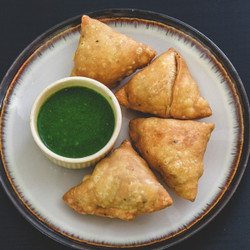
If serving right away then keep frying until they get golden brown and crisp. One batch of samosa will take around 7-8 minutes for frying to perfection.
Drain the excess oil with the help of a perforated spoon and remove it to a plate.