 Sort ingredients
 jleduc
 QR Code
 Listen
 Pdf
Pdf
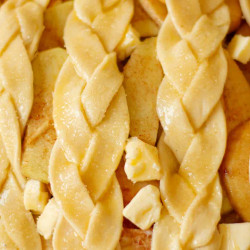
Prepare the ice water and slice some of the butter: Fill a 1-cup liquid measure with ice water and refrigerate it while you assemble the pie dough. Cut a 5 tablespoon block of the butter (2.5 oz / 71g) crosswise into ⅛-inch- thick slices (so you have lots of thin butter squares) and refrigerate.
Mix the dry ingredients: In a large bowl, whisk together the flour, sugar, and salt to combine.
Work the butter into the dry ingredients: Cut the remaining 5 tablespoons butter into ½-inch cubes and toss in the flour mixture to coat. Quickly and firmly use your fingertips to smash the butter pieces into the flour, flattening them and working into smaller bits until the largest pieces are no bigger than a pea.
Remove the butter slices from the refrigerator, add them to the flour mixture, toss to coat, then flatten between your thumbs and fingertips into thin sheets, letting them break apart if that’s what they want to do. Once you’ve worked in all the butter, you should have a very coarse, slightly yellowed mixture filled with some larger pieces of butter and some very small bits.
Bring the dough together: Slowly drizzle 5 tablespoons of the ice water (avoiding any ice) into the mixture, tossing constantly with a fork to incorporate. Switch to your hands and toss the mixture several times until shaggy pieces of dough form, then knead the mixture inside the bowl a few times to bring it together (the dough will look very clumpy and dry, with loose bits).
Line the work surface with a sheet of plastic wrap, then transfer any large clumps of dough to the plastic. Tossing again with a fork, drizzle more ice water 1 teaspoon at a time into the bowl with the remaining flour mixture until only a few dry spots remain, then knead with your hands to bring it together into a dough. Transfer the last bits of dough to the plastic wrap.
Wrap and chill the dough: Pat the dough into a ¾-inch-thick square or rectangle. Wrap tightly in the plastic, pressing out any air, and press down on the dough with the heel of your hand to flatten it further and force it into the corners of the plastic. Refrigerate for 2 hours.
Roll out and fold the dough: Let the dough sit on the counter for 5 minutes to soften slightly. Unwrap it and place on a lightly floured surface. Use a rolling pin to beat the dough all across the surface to make it more pliable. Dust the top and underside of the dough with more flour, then roll it out, dusting with more flour as needed, into a rectangle that’s about three times longer than it is wide and between ¼ and ½ inch thick.
Fold the dough in thirds like a letter (this makes more butter layers, which create a flaky texture), then wrap tightly in plastic. Refrigerate the dough until it’s relaxed, at least 30 minutes and up to 3 days.
If baking, preheat the oven and prepare a baking sheet: Arrange an oven rack in the center position and preheat the oven to 425°F. Line a rimmed baking sheet with foil and set aside.
Line a 9-inch pie plate: Let the pie dough sit at room temperature for about 5 minutes to soften slightly, then beat it across the surface again with a rolling pin to make it more pliable. Dust the top and underside of the dough with more flour, then roll it out, dusting with more flour as needed, into a 13-inch round that’s about ⅛ inch thick. Roll the pastry onto the rolling pin.
Unroll the round onto a 9-inch pie plate, preferably glass, letting the pastry slump gently down the sides into the bottom. Firmly press the pastry into the bottom and up the sides of the plate, ensuring contact everywhere and taking care not to stretch it.
Use scissors to trim around the edge of the pastry, leaving a ½-inch overhang (discard the scraps). Tuck the overhang underneath itself all the way around so you have a lip of double-thick pastry resting just around the rim of the pie plate.
Press down firmly around the rim to seal, then crimp the crust all the way around, using the thumb of one hand and the thumb and forefinger of the other, flouring your fingers if needed to prevent sticking. Instead of a crimp, you can also use the tines of a fork to create hash marks around the rim.
Bake the weighted crust: Freeze the lined pie plate until the dough is very firm, about 10 minutes, then prick the bottom of the pastry in several places with a fork to prevent the crust from puffing up. Line the inside of the pie plate with two pieces of foil, arranged perpendicularly, so the overhang of the foil completely covers the edge of the crust.
Fill the pie plate with pie weights, dried beans, or rice and place on the prepared baking sheet. Bake in the center of the oven until the edge of the crust is set and starting to turn golden when you peek under the foil, 25 to 30 minutes.
Remove the plate from the oven and carefully lift the foil and pie weights out of the crust. Reduce the oven temperature to 350°F.
To par- or fully bake the crust: Return the pan to the oven and bake until the crust is golden brown all over, another 20 to 25 minutes for a parbaked crust, or until deep golden brown all over, 10 to 15 minutes longer, for a fully baked crust. Set the crust aside to cool.