 Sort ingredients
 maiviluu
 QR Code
 Listen
 Pdf
Pdf
Add 125 g (½ cup) active sourdough starter, 500 g (4 cups) bread flour, 312 g (1⅓ cups) water into a large bowl. Combine using a Danish dough whisk until all ingredients are mixed.
Cover the bowl and let the dough rest for 30 minutes. This allows the flour to properly hydrate.
Add 15 g salt and 28 g (2 tbsp) warm water to a small bowl and stir to dissolve the salt. Pour the salt water into the bowl and pinch it into the dough until it's completely mixed in. Cover and rest for 30 minutes.
Stretch and fold the dough to strengthen the gluten. The dough begins as a shaggy dough and transforms into a smooth, elastic dough by the final set of stretch and folds.
Grab the edge of the dough and lift it straight up, stretching the dough, before folding it over onto itself in the middle of the dough. Rotate the bowl a quarter turn and stretch and fold the dough again. Repeat stretching and folding and rotating the bowl until the dough starts to feel resistant, roughly 6-8 folds.
Cover the bowl with a kitchen towel or a piece of plastic wrap. Let the dough rest for 30 minutes. This completes the first set of stretch and folds.
Continue for a total of 3 sets of stretch and folds with 30 minute intervals.
After the last set of stretch and folds, cover the bowl and allow it to bulk ferment in a warm place in the kitchen.
The dough is ready when the top of the dough is domed and you see bubbles beneath the surface of the dough and it has almost doubled in size.
Turn the dough out onto a lightly floured work surface using a bowl scraper or silicone spatula. Stretch the dough into a 10 X 10 square. Sprinkle half of the cheddar cheese over the dough, leaving a 1-inch border. Follow with half of the diced jalapenos.
Fold the bottom half of the dough up to the middle of the dough. Next, fold the top down, overlapping the bottom half.
Sprinkle the remaining cheese and jalapenos over the dough. Roll the dough, starting at one end of the dough, until it forms a large ball.
Once the dough is rolled into a large ball, pinch the sides together, sealing the inclusions into the middle of the dough.
Gently shape the dough by cupping the far edge of the dough and pull it towards yourself. This creates tight surface tension which helps for a tall loaf.
Prepare a banneton by dusting it with a bit of rice flour to prevent the dough from sticking.
Lift the shaped dough into the prepared banneton with the top of the dough facing down and the seams facing up. Pinch together any open seams close.
Place the banneton in a plastic bag and refrigerate for 12 - 24 hours.
The next day preheat the Dutch oven and lid at 450°F/230°C for 45 minutes.
Remove the dough from the fridge, place a piece of parchment paper on the banneton, and flip it over, letting the dough fall onto the piece of parchment paper. Score the top of the dough with a sharp knife or razor blade.
Carefully lift the dough into the preheated Dutch oven, replace the lid, and place the Dutch oven back into the oven.
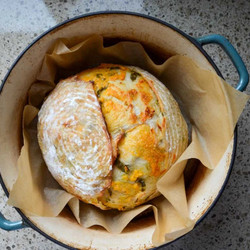
Bake for 35 minutes with the lid on. Remove the lid and bake for an additional 15 minutes. The bread is done when the top is golden brown and the internal temperature reaches 200°F with a digital thermometer.
Remove the bread from Dutch oven and place on a wire rack. Cool completely before cutting to avoid a gummy texture.