 Sort ingredients
 auntlainey
 QR Code
 Listen
 Pdf
Pdf
Take 25 grams of leftover sourdough starter (room temperature or from the fridge) and feed it 100 grams of bread flour and 100 grams of water. Mix everything together in a jar until well combined and there aren't any dry bits of flour in the jar.
Mark the top of the starter with a rubber band and let it rest at room temperature (or in a warm spot in your house) for 4-8 hours, or until it doubles in size. When the starter has grown to about double its original size, you can continue on with the recipe and mix it into the dough.
Into a mixing bowl, weigh out all of the water, milk, risen sourdough starter, melted butter, sugar, and salt. Stir these ingredients together until they are well combined and the starter is dissolved.
Next, add the bread flour into the mixing bowl with all of the other ingredients.
Stir everything together until the flour is hydrated and a rough dough has formed. Scrape down the sides of the mixing bowl.
Cover up the bowl with a kitchen towel and let the dough rest for 10-15 minutes. This short rest period will allow the flour to hydrate and help the dough to hold together better during the kneading process.
After the short rest, knead the dough by hand for 6-8 minutes either on the kitchen counter or inside of the mixing bowl. The dough should become relatively smooth during the kneading process.
Once the dough is kneaded for the correct amount of time, form it into a ball, place it into the mixing bowl, and cover it up with a kitchen towel.
Let the dough rise for 3-6 hours at room temperature (or in a warm spot in your house) until it is roughly doubled in size. You don’t knead to do any folding or kneading during this rising period. Just let the dough relax and the sourdough starter will do its magic!
When the dough is almost fully doubled in size, grease a 2 lb Pullman-style loaf pan with butter or vegetable oil. The Pullman pan that I like to use (see it here on Amazon) is very non-stick, and doesn’t actually need to be greased with butter, but I like to grease the pan for this bread because of the lightly caramelized flavor that the butter provides.
Make sure to grease the bottom, sides, and corners of the pan, and don’t forget to grease the inside of the lid as well.
When the dough has risen to roughly twice its size, it should feel somewhat puffy and inflated with air. It’s time to shape the dough for the pan.
Dust your kitchen counter very lightly with flour. Turn the dough out onto the floured counter with the seam side facing up and the smooth side against the counter.
Flatten the dough into a disc, and stretch it into a rectangle that is a little bit smaller than the length of your bread pan. We don’t need airy bubbles in this style of sourdough bread, so it’s OK to knock most the air out.
Take the rectangular dough and roll it into a cylinder. Then transfer the dough into your bread pan with the seam side facing down. Now your dough is shaped and ready to proof!
Cover the dough up by putting attaching the Pullman pan lid on top of the pan.
Let the dough proof/rise for 3-6 hours, or until it gets close to reaching the top of the pan. Once it almost reaches the top, it’s ready to bake.
Preheat your oven to 400°F for at least 30 minutes to ensure that the oven is actually at the right temperature.
Place the dough into the middle rack of the oven with the lid securely on top of the pan. The lid will trap steam around the dough, assuring that it bakes will with a very lightly crisp, and thin crust.
Bake the sourdough Pullman loaf for 45 minutes with the lid on.
After 45 minutes, remove the pan from the oven and take off the lid. Transfer the bread out of the pan and onto a wire rack. If the bread is golden brown and reaches 190°F with a probe thermometer, it’s fully baked and you can let it cool on the wire rack.
If the bread looks a little bit pale and/or the internal temperature doesn’t quite reach 190°F, put the bread on a sheet pan and slide it back into the oven. Keep baking for 5-10 more minutes and check the bread again. After 10 additional minutes baking on a tray, your loaf should be golden brown and ready to cool.
Carefully take the loaf of bread out of the oven and transfer it onto a wire rack. Let t=he bread cool on the wire rack for at least one hour before you slice into the loaf.
Once cooled, slice the loaf with a good bread knife.
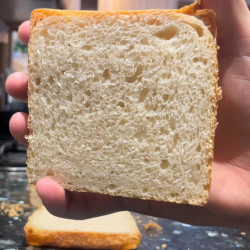
Even without a great bread knife, this sourdough pullman loaf would be easy to slice! Because the square pan traps steam around the loaf while it’s baking, it doesn’t have much time to form a thick crust, leaving you with a delicate, thin-crusted, and easy-to-slice loaf of sourdough bread.
Enjoy the lightly sweet and complex flavors of this sourdough sandwich bread. This bread is perfect for a peanut butter and jelly sandwich or a good slice of buttered toast.