 Sort ingredients
 that_vegetarian
 QR Code
 Listen
 Pdf
Pdf
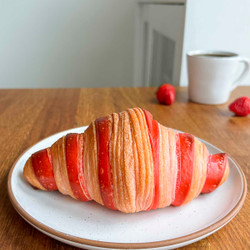
Instructions Note: My recipe is an adaptation of the NYT croissant recipe, using sourdough instead of yeast. I linked to their video for each step of the process so that you have helpful visual cues to perform each step.
(Optional) Make strawberry milk: This step can be omitted and you can simply use plain whole milk for this recipe, but if you’d like to add an extra burst of strawberry flavor, this is a great way to do it! Add the milk and fresh strawberries to a blender and blend on high speed until smooth. Reserve 112g total (½ cup) of the strawberry milk for step 2 and the rest can be used for anything else or enjoyed as is!
Mix the dough (détrempe): In the bowl of a stand mixer, add flour, sugar, salt, milk (or strawberry milk if you made it in Step 1), sourdough starter, water, pink all-natural plant-based food coloring (to make the dough light pink), crushed freeze-dried strawberries, and optional active dry yeast if using. (Note: adding a tiny percentage of active dry yeast can achieve a proper fermentation process without taking a way any of the benefits of sourdough!). Mix on low speed with the dough hook attachment for 1 minute. Add the softened butter and continue mixing, scraping down the sides as needed, until a smooth dough forms about 3-4 minutes).600g all purpose flour, 65 g sugar, 12g salt, (optional: 1.5g active dry yeast), 205g water, 112g whole milk (or strawberry milk), 60g sourdough starter, (optional: pink food coloring)
Make the dark pink dough: Remove the dough from the mixing bowl and slice off approximately 20% of it (~225g). Add the small (225g) piece back into your mixing bowl and add more of the all natural plant based pink food coloring and a little all-natural planted-based red food coloring. Mix until combined, and add more pink/red if needed until you achieve a hot pink color that is darker than the larger dough.
First rise: Shape both doughs into a ball and place each in a separate bowl. Optional: Add the dampened whole freeze dried strawberry slices to the main light pink dough for added flavor, color, and texture. Cover both doughs and let rise at room temperature for 3 - 6 hours. Once your doughs have increased in volume by roughly 1.5x, transfer to the fridge for a minimum of 4 hours or overnight (~12 hours).
Make the butter block: Here is a helpful video of Claire Saffitz demonstrating how to make a butter block at home. Start by laying out a large sheet of parchment paper. Place your sticks of butter next to each other in the center of the paper, and fold the sides of the paper over to fully enclose the butter. Flip the parchment paper over so that the folds are against the table. Using a rolling pin, lightly beat the butter into a ½’’ thick layer. Remove the butter from the parchment paper and re-wrap the butter, measuring the parchment paper so that it forms an 8’’ square. The ½’’ butter layer should be smaller than the 8’’ parchment paper square. Flip the packet over again and beat the butter into an 8’’x8’’ square that fills our the parchment paper. Refer to the video linked above for helpful visual cues for this process. Eventually, it will be easy to roll the butter out to the edges of the parchment paper and get a clean square shape. Place the butter in the fridge to firm up.340g unsalted butter, 84-86% butterfat
Prepare the dough for laminating: The next day, remove the main dough from the fridge and place it on a floured surface. Using your hand deflate the dough and form it into a square shape. Wrap the dough in plastic wrap on all sides. Using your rolling pin, roll the dough into a flat 8’’ x 8’’ square. Place the wrapped dough in the freezer for 20 minutes. Video: Preparing the Dough.
Roll the dough: Remove the butter from the refrigerator and the dough from the freezer. Unwrap the dough and place it on a lightly floured surface. Roll the dough, dusting with flour if needed, until it reaches 16’’ long while maintaining a width of 8 inches.
Lock in the butter: Place the butter in the center of the dough and peel off the parchment paper. The butter block should be aligned with the sides of the dough, with an equal amount of dough overhanging at the top and the bottom. Fold the overhanging flaps of the dough over the butter so that the two ends meet in the middle. If they don’t meet, gently tug until they do. Seal both sides of the dough together and pinch the remaining sides of the dough to full enclose the butter. Video: locking in the butter.
First Turn: Rotate the dough so the seam is vertical. Roll the dough, lengthwise, to create a 24’’ long sheet that is ¼’’ - ½’’ thick. With a knife or a dough cutter, trim the short ends of your rectangle so that you have a clean 24’’ long rectangle that is straight on all 4 sides. Take the shorter edge of the rectangle that’s farthest from you an fold it towards the center, lining up the edges. Press down lighty to make sure the dough sticks together. Do the same with the opposite side, leaving a small ⅛’’ gap between the edges in the middle. Next, fold the entire dough in half along this gap, bringing the top half down over the bottom half. At this point, you should have a recangular packet of dough, also known as a “book,” with four layers. This technique is referred to as the “first turn” or “book fold” and it quadruples the butter layers within the dough. Video: First Turn - Book Fold.
Rest the dough: Wrap the dough tightly in plastic wrap and place in the freezer for 15 minutes, then refrigerate for 1 hour.
Simple turn (second turn): Remove the dough from the fridge and let it sit at room temperature for about 5 minutes. Lightly flour your work surface and roll out the dough into a 24''x8'' rectable again, creating a long, narrow slab about ⅜’’ thick. Fold the dough into thirds. This is called the “simple turn,” and it triples the layers in the dough. Warp the dough again in plastic wrap and freeze for 15 minutes, then refrigerate for 1 hours. Video: Simple Turn.
Add the red layer: Remove the red dough from the fridge and place on a floured work surface. Roll the dough out out so that it’s the same size square as your main dough (about 8’’x8’’).Remove the main dough from the fridge and place on your floured work surface. Using a spray bottle or damped pastry brush, gently dampen the top of the main dough with a little bit of water. Add the red dough on top and gently beat with your rolling pin to make sure it sticks. Video: Adding a dough layer for bi-color croissants.
Preshape the dough: Flip your dough over so that the red layer is against the table. Using your rolling pin, roll the dough out into a 14’’ x 17’’ rectangle. Wrap and freeze for 20 minutes then refrigerate overnight, between 8-12 hours.
Slice the dough: Remove the dough from the fridge and place it on a lightly floured surface. If necessary, re-roll the dough so that it’s a 14’’ x 17’’ rectangle. Carefully dust off any extra flour with a pastry brush. Use a knife or wheel cutter to trim any uneven edges so that you have a nice clean rectangle that’s exactly 14’’x16’’ now. Now slice the dough into four 4’’ x 14’’ rectangles. Starting with one rectangle, use a knife/wheel cutter and a ruler to slice a straight line from one corner of the rectangle to it’s opposite corner, creating two long equal triangles. Repeat the process with the remaining rectangles to create 8 triangles. Video: Shaping Croissants.
Roll the croissants: Using a knife or a wheel cutter, trim the base of your triangle to ensure it’s a nice straight line – you’re just looking to clean it up a bit, so trim as little as possible. Starting one triangle at a time, widen the base by gently tugging on the 2 corners of the bottom of the triangle. You’re looking to achieve a 3’’ base of the triangle. Then, running your fingers along the length of the triangle towards the point, gently pull to lengthen the triangle. Now you’re ready to roll it into a croissant! Lay out one triangle so that the dark pink side is against the table and the light pink side is facing up. Then, starting at the base of the triangle, roll the dough towards the tip to form a cresent shaped croissant. Repeat this process with all 8 triangles. Place the shaped croissants on a parchment-lined baking tray and cover loosely with plastic wrap.
Proof the croissants: There are two options for this step.Option 1 - Room temperature proof: Proof at room temperature for 4-6 hours until the croissants are jiggly and have roughly doubled in size.Option 2 - Faster proof with steam: Using a proofing box, countertop oven with a proof setting, or placing a pan filled with warm water in an oven to create steam, proof your croissants at 70F-75F for 2-3 hours until jiggly and doubled in size.
(Optional) Make the pastry cream: If you’d like to pipe your croissants with a delicious strawberry pastry cream, now is a great time to prepare that because it needs to sit for about 3 hours before it’s ready to pipe. Use the Strawberry Pastry Cream recipe outlined below.
Preheat oven and chill croissants: Once your croissants are done proofing, preheat your oven to 375F. Transfer the croissants to the fridge to chill for 15-20 minutes.
Egg wash: In a small bowl, whisk together the egg and heavy cream. Remove your croissants from the fridge. Using a pastry brush, apply the egg wash to tops of the croissants on the dark pink lines of dough, not the exposed light pink sides. Video: Egg wash.
Bake the croissants: Bake for 15 minutes. Rotate the sheet and bake for an additional 10-15 minutes until deep golden brown. Cool completely on baking sheets.
Optional, Fill croissants: Fill a piping bag with a small piping tip attached. with the strawberry pastry cream. Use a small piping tip or skewer to poke a hole on the bottom side of each croissant by inserting the skewer three quarters of the way inside the croissant and rotating a few times to widen the opening. Insert the piping tip into the croissant and fill with strawberry pastry cream until the cream begins to poke out of the hole.
Enjoy your homemade sourdough croissants as is or with a delightful strawberry pastry cream filling!
Heat the milk: Pour 1.5 cups of the milk into a saucepan, and heat over medium heat to bring it to a simmer. Don’t bring to a full boil.375g (1.5 cups) whole milk
Whisk the remaining ingredients: In a separte bowl, add the egg yolks, sugar, cornstarch, remaining milk, and salt and whisk together.125g (½ cup) milk, 67g (⅓ cups) granulated sugar, 40g (4 Tbsp) cornstarch, 2 large eggs, 2 tsp vanilla bean paste, ¼ tsp salt
Pour in the milk: Once the milk reaches a swimmer remove it from the heat. Slowly pour the steaming hot milk into the bowl with the other ingredients, whisking constantly to temper the eggs. One the eggs have tempered, pour the mixture back into the saucepan.
Heat the mixture: Return the saucepan to the stove and heat over medium high heat, whisking constantly until the mixture starts to thicken and bubbles form. Lower the heat and cook for another 1-2 minutes. Remove from the heat.
Cover: Allow the pastry cream to cool for a few minutes, then place plastic wrap directly on top to prevent a skin from forming. Refrigerate for at least 3 hours.
Add the strawberries: Remove the mixture from the fridge and pour in the pureed fresh strawberries. Whisk together to create a strawberry swirl.
Add to a piping bag: Pour the mixture into a piping bag and use it for your croissants!