 Sort ingredients
 trikota
 QR Code
 Listen
 Pdf
Pdf
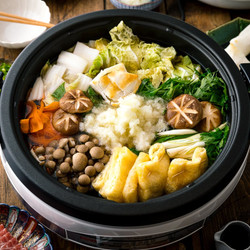
Gather all the ingredients.
In a large pot (heavy-bottomed pot, donabe, or electric hot pot like this one), add 4 cups water and 1 piece kombu (dried kelp).
Add 3 Tbsp sake, 1 Tbsp mirin, 2 Tbsp soy sauce, and 1 tsp Diamond Crystal kosher salt to the pot. Mix them all together and set aside.
Napa cabbage: Remove the core of ½ head napa cabbage, separate the leaves, and rinse them carefully. Then, cut them into 2-inch (5-cm) pieces.
Cut the tough bottom part of the leaves into smaller strips/pieces.
Mizuna: Cut 1 bunch mizuna (Japanese mustard green) into 2-inch (5-cm) pieces.
Carrots: Using a vegetable peeler, peel 2 carrots into thin ribbons.
Negi and green onion: Cut 1 Tokyo negi (naga negi; long green onion) diagonally into ½-inch (1.3-cm) pieces. Thinly slice 1 green onion/scallion.
Shimeji and shiitake mushrooms: Discard the bottom of 1 package shimeji mushrooms and separate them. Remove the stems of 4 shiitake mushrooms.
If you‘d like, you can carve the mushroom caps to make them look like a flower by following my shiitake hanagiri tutorial.
Aburaage and kiri mochi (option 1; mochi bag): Cut 2 pieces aburaage (deep-fried tofu pouch) and 4 pieces Japanese rice cake (mochi) in half.
Stuff the kiri mochi into the aburaage pocket. Using a toothpick, seal the opening.
Aburaage (option 2): If you don‘t want to make mochi bags, you can simply cut the aburaage into bite-size pieces.
Kiri mochi (option 2): Simply toast the mochi in the toaster oven until it becomes puffy.
Daikon radish: Peel and grate 1 daikon radish using a grater (I use a ceramic grater).
Drain the grated daikon to remove excess moisture (liquid) by gently pressing it down. Transfer to a bowl and set aside.
Put all the ingredients on a large platter (or several platters). Prepare small individual bowls each filled with 2 Tbsp ponzu and some chopped green onion.
Bring the broth to a boil over medium heat. If you‘re adding root vegetable chunks (carrot, gobo, etc.), start cooking them while you are heating up the broth. They take a longer time to cook. Right before boiling, discard the kombu (or use it later to make Furikake Rice Seasoning or Simmered Kombu).
Once boiling, add various kinds of ingredients to the pot and arrange them by sections. For example, group the napa cabbage in one area while mushrooms stay in one area. This way, you can choose what you want to eat. Close the lid and cook for 8–10 minutes. Keep an eye on leafy greens. Dish them out early if they turn soft and ready to eat. Dip the cooked food in ponzu sauce to enjoy. To cook the meat, add a few slices of the 1 lb thinly sliced pork loin to the simmering broth and cook for 30 seconds. Do not overcook. Once all the cooked ingredients are served and cleared from the hot pot, add a new batch of ingredients. Cover the lid and start cooking for 10 minutes. Add water if the broth is low in the pot. Repeat 1–2 more rounds until you finish all the ingredients.
You can keep the leftovers in an airtight container and store them in the refrigerator for up to 2 days.